





Skip to content
  • Categories
  • Recent
  • Tags
  • Popular
  • Unsolved
Collapse
Discussion Forum to share and further the development of home control and automation, independent of platforms.
  1. Home
  2. Software
  3. Multi-System Reactor
  4. How do I set parameters in Home Assistant from MSR
Condition for trend
T
Topic thumbnail image
Multi-System Reactor
Set reaction triggering wrong z-wave device
T
Topic thumbnail image
Multi-System Reactor
Can you run MSR on Home Assistant OS ?
cw-kidC
Looking at using Home Assistant for the first time, either on a Home Assistant Green, their own hardware or buying a cheap second hand mini PC. Sounds like Home Assistant OS is linux based using Docker for HA etc. Would I also be able to install things like MSR as well on their OS ? On the same box? Thanks.
Multi-System Reactor
How to upgrade from an old version of MSR?
cw-kidC
Hello I haven't updated my installation of MSR in a very long time. Its a bare metal Linux install currently on version 24366-3de60836 I see the latest version is now latest-26011-c621bbc7 I assume I cannot just jump from a very old version to the latest version? Or can I? Thanks
Multi-System Reactor
This trigger no longer working - complaining about the operator needing changing
cw-kidC
Topic thumbnail image
Multi-System Reactor
Self test
CatmanV2C
Having been messing around with some stuff I worked a way to self trigger some tests that I wanted to do on the HA <> MSR integration This got me wondering if there's an entity that changes state / is exposed when a configured controller goes off line? I can't see one but thought it might be hidden or something? Cheers C
Multi-System Reactor
Access control - allowing anonymous user to dashboard
tunnusT
Using build 25328 and having the following users.yaml configuration: users: # This section defines your valid users. admin: ******* groups: # This section defines your user groups. Optionally, it defines application # and API access restrictions (ACLs) for the group. Users may belong to # more than one group. Again, no required or special groups here. admin_group: users: - admin applications: true # special form allows access to ALL applications guests: users: "*" applications: - dashboard api_acls: # This ACL allows users in the "admin" group to access the API - url: "/api" group: admin_group allow: true log: true # This ACL allows anyone/thing to access the /api/v1/alive API endpoint - url: "/api/v1/alive" allow: true session: timeout: 7200 # (seconds) rolling: true # activity extends timeout when true # If log_acls is true, the selected ACL for every API access is logged. log_acls: true # If debug_acls is true, even more information about ACL selection is logged. debug_acls: true My goal is to allow anonymous user to dashboard, but MSR is still asking for a password when trying to access that. Nothing in the logs related to dashboard access. Probably an error in the configuration, but help needed to find that. Tried to put url: "/dashboard" under api_acls, but that was a long shot and didn't work.
Multi-System Reactor
VEC Virtual Switch Auto Off
S
I use Virtual Entity Controller virtual switches which I turn on via webhooks from other applications. Once a switch triggers and turns on, I can then activate associated rules. I would like each virtual switch to automatically turn off after a configurable time (e.g., 5 seconds, 10 seconds). Is there a better way to achieve this auto-off behavior instead of creating a separate rule for each switch that uses the 'Condition must be sustained for' option to turn it off? With a large number of these switches (and the associated turn-off rules), I'm checking to see if there is a simpler approach.If not, could this be a feature request to add an auto-off timer directly to the virtual switches. Thanks Reactor (Multi-hub) latest-26011-c621bbc7 VirtualEntityController v25356 Synology Docker
Multi-System Reactor
Upcoming Storage Change -- Got Back-ups?
toggledbitsT
TL;DR: Format of data in storage directory will soon change. Make sure you are backing up the contents of that directory in its entirety, and you preserve your backups for an extended period, particularly the backup you take right before upgrading to the build containing this change (date of that is still to be determined, but soon). The old data format will remain readable (so you'll be able to read your pre-change backups) for the foreseeable future. In support of a number of other changes in the works, I have found it necessary to change the storage format for Reactor objects in storage at the physical level. Until now, plain, standard JSON has been used to store the data (everything under the storage directory). This has served well, but has a few limitations, including no real support for native JavaScript objects like Date, Map, Set, and others. It also is unable to store data that contains "loops" — objects that reference themselves in some way. I'm not sure exactly when, but in the not-too-distant future I will publish a build using the new data format. It will automatically convert existing JSON data to the new format. For the moment, it will save data in both the new format and the old JSON format, preferring the former when loading data from storage. I have been running my own home with this new format for several months, and have no issues with data loss or corruption. A few other things to know: If you are not already backing up your storage directory, you should be. At a minimum, back this directory up every time you make big changes to your Rules, Reactions, etc. Your existing JSON-format backups will continue to be readable for the long-term (years). The code that loads data from these files looks for the new file format first (which will have a .dval suffix), and if not found, will happily read (and convert) a same-basenamed .json file (i.e. it looks for ruleid.dval first, and if it doesn't find it, it tries to load ruleid.json). I'll publish detailed instructions for restoring from old backups when the build is posted (it's easy). The new .dval files are not directly human-readable or editable as easily as the old .json files. A new utility will be provided in the tools directory to convert .dval data to .json format, which you can then read or edit if you find that necessary. However, that may not work for all future data, as my intent is to make more native JavaScript objects directly storable, and many of those objects cannot be stored in JSON. You may need to modify your backup tools/scripts to pick up the new files: if you explicitly name .json files (rather than just specifying the entire storage directory) in your backup configuration, you will need to add .dval files to get a complete, accurate backup. I don't think this will be an issue for any of you; I imagine that you're all just backing up the entire contents of storage regardless of format/name, that is the safest (and IMO most correct) way to go (if that's not what you're doing, consider changing your approach). The current code stores the data in both the .dval form and the .json form to hedge against any real-world problems I don't encounter in my own use. Some future build will drop this redundancy (i.e. save only to .dval form). However, the read code for the .json form will remain in any case. This applies only to persistent storage that Reactor creates and controls under the storage tree. All other JSON data files (e.g. device data for Controllers) are unaffected by this change and will remain in that form. YAML files are also unaffected by this change. This thread is open for any questions or concerns.
Multi-System Reactor
Oddness in Copy/Move of Reactions
G
Topic thumbnail image
Multi-System Reactor
[Solved] function isRuleEnabled() issue
CrilleC
Topic thumbnail image
Multi-System Reactor
[Reactor] Problem with Global Reactions and groups
therealdbT
Topic thumbnail image
Multi-System Reactor
Possible feature request 2?
CatmanV2C
Just another thought. Adding devices from my Home Assistant / Zigbee2MQTT integration. Works perfectly but they always add as their IEEE address. Some of these devices have up to 10 entities associated, and the moment they are renamed to something sensible, each of those entities 'ceases to exist' in MSR. I like things tidy, and deleting each defunct entity needs 3 clicks. Any chance of a 'bulk delete' option? No biggy as I've pretty much finished my Z-wave migration and I don't expect to be adding more than 2 new Zigbee devices Cheers C
Multi-System Reactor
Reactor (Multi-System/Multi-Hub) Announcements
toggledbitsT
Build 21228 has been released. Docker images available from DockerHub as usual, and bare-metal packages here. Home Assistant up to version 2021.8.6 supported; the online version of the manual will now state the current supported versions; Fix an error in OWMWeatherController that could cause it to stop updating; Unify the approach to entity filtering on all hub interface classes (controllers); this works for device entities only; it may be extended to other entities later; Improve error detail in messages for EzloController during auth phase; Add isRuleSet() and isRuleEnabled() functions to expressions extensions; Implement set action for lock and passage capabilities (makes them more easily scriptable in some cases); Fix a place in the UI where 24-hour time was not being displayed.
Multi-System Reactor
Copying a global reaction
tunnusT
With build 25328, if you copy a global reaction, a new reaction does not appear in the UI unless you do a refresh. I recall this used to work without needing this page refresh? Anyway, only a minor nuisance.
Multi-System Reactor
[Reactor] Bug when sending MQTT boolean payloads
therealdbT
Topic thumbnail image
Multi-System Reactor
Difficulty defining repeating annual period
R
I have tried numerous ways to define a recurring annual period, for example from December 15 to January 15. No matter which method I try - after and before, between, after and/not after, Reactor reports "waiting for invalid date, invalid date. Some constructs also seem to cause Reactor to hang, timeout and restart. For example "before January 15 is evaluated as true, but reports "waiting for invalid date, invalid date". Does anyone have a tried and true method to define a recurring annual period? I think the "between" that I used successfully in the past may have broken with one of the updates.
Multi-System Reactor
Need help with sequence
T
Good evening all, For about the past week or so, I've been having problems with a specific rule in my home automation that controls when my home goes from an Away mode to Home mode. One of the conditions it checked for was my alarm panel, when it changed from Armed Away to Disarmed. There seems to have been a firmware update on the panel that added an intermittent step of "pending", and I can't say for certain it happens 100% of the time. Is there a way to write a condition that so it changes from one condition, to the next, and then another condition? As in, Home alarm changes from armed_away to pending to disarmed. Thanks.
Multi-System Reactor
Possible feature request?
CatmanV2C
No idea how easy this would be. During my migration away from Z-wave I've been replacing the Z-wave devices with Sonoff which has broken some of my automations. Any chance of a 'Test Reaction' function to call out which ones are broken because an entity no longer exists? Without actually running the reaction? Or does this exist already and I'm just not aware of how to do it? Obviously I can see entities that are no longer available, but not quite what I'm looking for. I guess it's something of an edge case so no huge issue. TIA! C
Multi-System Reactor
Logic Assistance: Exterior Lights on when Illuminance Below Threshold
PablaP
Topic thumbnail image
Multi-System Reactor

How do I set parameters in Home Assistant from MSR

Scheduled Pinned Locked Moved Multi-System Reactor
9 Posts 2 Posters 1.0k Views 2 Watching
  • Oldest to Newest
  • Newest to Oldest
  • Most Votes
Reply
  • Reply as topic
Log in to reply
This topic has been deleted. Only users with topic management privileges can see it.
  • T Offline
    T Offline
    tamorgen
    wrote on last edited by tamorgen
    #1

    Good morning,
    I've finally migrated all my devices and logic over from my old Vera Plus to Home Assistant. The only remaining logic I had was a parameter lua call that I used in Vera to set the LED light on some Z-wave switches and outlets to off when it was bed time. I can set them in Home Assistant directly under the device tab, but I don't see how to do it through MSR. Can someone tell me how to do this?

    I'm running the latests MSR (22293) and I'm running Home Assistant 2022.10.4, 9.2 HA OS.

    1 Reply Last reply
    0
    • toggledbitsT Offline
      toggledbitsT Offline
      toggledbits
      wrote on last edited by
      #2

      Not showing your work here, and missing detail available and needed. It would be useful to know what the device(s) is/are, and what you know about those devices/how the LEDs are manipulated, and you should show what you are doing in HA (screen shot service calls or similar work you've done there to make it happen).

      Author of Multi-system Reactor and Reactor, DelayLight, Switchboard, and about a dozen other plugins that run on Vera and openLuup.

      T 1 Reply Last reply
      0
      • toggledbitsT toggledbits

        Not showing your work here, and missing detail available and needed. It would be useful to know what the device(s) is/are, and what you know about those devices/how the LEDs are manipulated, and you should show what you are doing in HA (screen shot service calls or similar work you've done there to make it happen).

        T Offline
        T Offline
        tamorgen
        wrote on last edited by
        #3

        @toggledbits said in How do I set parameters in Home Assistant from MSR:

        Not showing your work here, and missing detail available and needed. It would be useful to know what the device(s) is/are, and what you know about those devices/how the LEDs are manipulated, and you should show what you are doing in HA (screen shot service calls or similar work you've done there to make it happen).

        Patrick,
        These are GE Enbrighten Z-wave devices. In Vera, I would run a lua command:

        luup.call_action('urn:micasaverde-com:serviceId:ZWaveNetwork1','SendData',{Node='48',Data='112 4 3 1 2'},1)luup.call_action('urn:micasaverde-com:serviceId:ZWaveNetwork1','SendData',{Node='49',Data='112 4 3 1 2'},1)luup.call_action('urn:micasaverde-com:serviceId:ZWaveNetwork1','SendData',{Node='70',Data='112 4 3 1 2'},1)return true

        In Home Assistant, I can manually change the parameter.
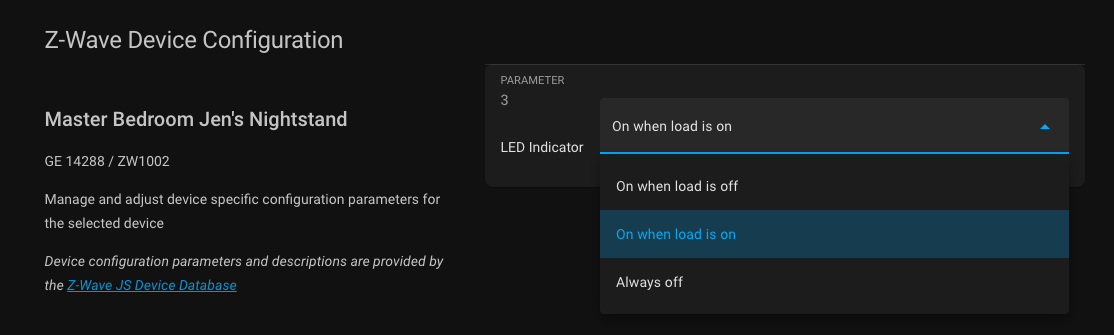
        451615e9-81e0-4625-85a4-7868f672b5c0-image.png

        Like I said, I want to be able to turn it to "Always Off" in this case, when it's night time and we're asleep. When it's day time again, I want to change i back to "On when load is off"

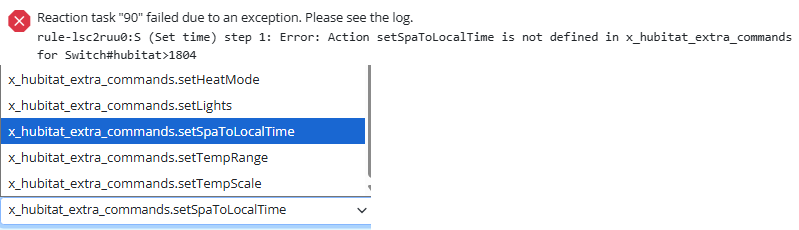
        In MSR, I do not see any sort of parameter setting for the same device.
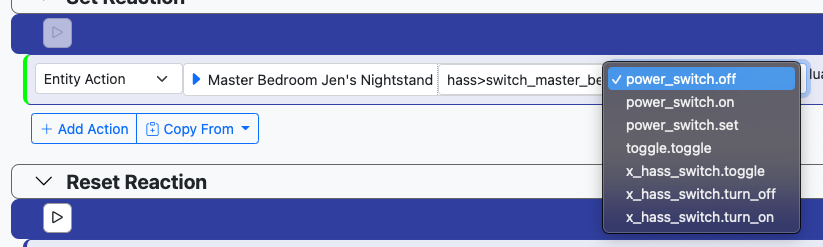
        Screen Shot 2022-10-25 at 8.14.01 AM.png

        toggledbitsT 1 Reply Last reply
        0
        • T tamorgen

          @toggledbits said in How do I set parameters in Home Assistant from MSR:

          Not showing your work here, and missing detail available and needed. It would be useful to know what the device(s) is/are, and what you know about those devices/how the LEDs are manipulated, and you should show what you are doing in HA (screen shot service calls or similar work you've done there to make it happen).

          Patrick,
          These are GE Enbrighten Z-wave devices. In Vera, I would run a lua command:

          luup.call_action('urn:micasaverde-com:serviceId:ZWaveNetwork1','SendData',{Node='48',Data='112 4 3 1 2'},1)luup.call_action('urn:micasaverde-com:serviceId:ZWaveNetwork1','SendData',{Node='49',Data='112 4 3 1 2'},1)luup.call_action('urn:micasaverde-com:serviceId:ZWaveNetwork1','SendData',{Node='70',Data='112 4 3 1 2'},1)return true

          In Home Assistant, I can manually change the parameter.

          451615e9-81e0-4625-85a4-7868f672b5c0-image.png

          Like I said, I want to be able to turn it to "Always Off" in this case, when it's night time and we're asleep. When it's day time again, I want to change i back to "On when load is off"

          In MSR, I do not see any sort of parameter setting for the same device.

          Screen Shot 2022-10-25 at 8.14.01 AM.png

          toggledbitsT Offline
          toggledbitsT Offline
          toggledbits
          wrote on last edited by toggledbits
          #4

          @tamorgen Home Assistant's API is a little thin on publishing device information, sadly. While that has been getting better, it's still not good enough for Reactor to know, for example, that your switch is a Z-Wave device (crazy, right?). So, you get to provide that intelligence, at least until some day they expose the integration used for a device through their API. What information Reactor does get can be used to map some basic services, which is why you see power_switch.on, toggle.toggle, etc., available in the menu, but since HA hasn't/can't tell us it's a ZWaveJS device, Reactor can't do much more there.

          But, that doesn't mean you can't get it done. Everything in Home Assistant is driven by services. Each integration defines what services it has, and although Reactor can't know what integrations are being used, if you do, you can find the service to use. Reactor has a generic call_service action on HassController system devices that allows you to call any service in Home Assistant for just this purpose. Although it's not as user-friendly as using something like power_switch.on, it's very powerful and gets you to almost everything Home Assistant can do.

          For ZWaveJS, there's a zwave_js.set_config_parameter service that you can call to tell the ZWaveJS integration in Home Assistant to set a configuration parameter value on a device. This is documented in Home Assistants documentation for the ZWaveJS component/integration. The required data for the service is pretty straightforward, and pretty much what you'd expect: the (Hass) entity ID, the parameter number, and the new value. I don't have your GE switches on my Hass mesh, but here's a call to a device I do have to set parameter 172 to 300:
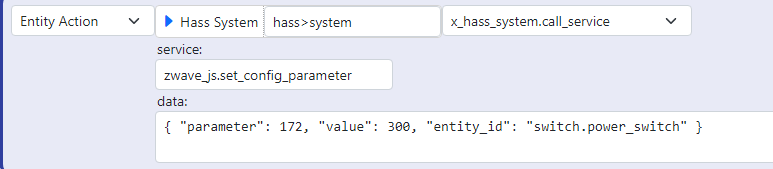
          db3521d0-084c-4aba-9a8a-8512625de9a7-image.png

          The x_hass_system.call_service action is found on your HassController's system entity in Reactor. From there, you just enter the service name, and format the data as JSON. I recommend using jsonlint.com to make sure you've got the data formed correctly. In your case, you would of course be setting parameter 3, and your entity ID would be switch.master_be... (I can't see the full ID because the menu is covering it in your screen shot). Remember that this has to be the Hass entity ID, not the Reactor entity ID (they are similar, but Hass has a dot after the first word, and Reactor uses underscore -- you want the dot version here).

          The reactor.log file will log this action and error that comes back from Hass, so be sure to look at that.

          FYI, I am working on a tighter integration between HassController and the UI to make call_service a bit more user-friendly (i.e. not require JSON for the data), but this is still a few weeks off at best. And that won't change the fact that their API doesn't give me a complete list of services a device supports, or what integration it's based on, so you are still going to have to provide that knowledge.

          Author of Multi-system Reactor and Reactor, DelayLight, Switchboard, and about a dozen other plugins that run on Vera and openLuup.

          T 2 Replies Last reply
          0
          • toggledbitsT toggledbits

            @tamorgen Home Assistant's API is a little thin on publishing device information, sadly. While that has been getting better, it's still not good enough for Reactor to know, for example, that your switch is a Z-Wave device (crazy, right?). So, you get to provide that intelligence, at least until some day they expose the integration used for a device through their API. What information Reactor does get can be used to map some basic services, which is why you see power_switch.on, toggle.toggle, etc., available in the menu, but since HA hasn't/can't tell us it's a ZWaveJS device, Reactor can't do much more there.

            But, that doesn't mean you can't get it done. Everything in Home Assistant is driven by services. Each integration defines what services it has, and although Reactor can't know what integrations are being used, if you do, you can find the service to use. Reactor has a generic call_service action on HassController system devices that allows you to call any service in Home Assistant for just this purpose. Although it's not as user-friendly as using something like power_switch.on, it's very powerful and gets you to almost everything Home Assistant can do.

            For ZWaveJS, there's a zwave_js.set_config_parameter service that you can call to tell the ZWaveJS integration in Home Assistant to set a configuration parameter value on a device. This is documented in Home Assistants documentation for the ZWaveJS component/integration. The required data for the service is pretty straightforward, and pretty much what you'd expect: the (Hass) entity ID, the parameter number, and the new value. I don't have your GE switches on my Hass mesh, but here's a call to a device I do have to set parameter 172 to 300:

            db3521d0-084c-4aba-9a8a-8512625de9a7-image.png

            The x_hass_system.call_service action is found on your HassController's system entity in Reactor. From there, you just enter the service name, and format the data as JSON. I recommend using jsonlint.com to make sure you've got the data formed correctly. In your case, you would of course be setting parameter 3, and your entity ID would be switch.master_be... (I can't see the full ID because the menu is covering it in your screen shot). Remember that this has to be the Hass entity ID, not the Reactor entity ID (they are similar, but Hass has a dot after the first word, and Reactor uses underscore -- you want the dot version here).

            The reactor.log file will log this action and error that comes back from Hass, so be sure to look at that.

            FYI, I am working on a tighter integration between HassController and the UI to make call_service a bit more user-friendly (i.e. not require JSON for the data), but this is still a few weeks off at best. And that won't change the fact that their API doesn't give me a complete list of services a device supports, or what integration it's based on, so you are still going to have to provide that knowledge.

            T Offline
            T Offline
            tamorgen
            wrote on last edited by
            #5

            @toggledbits

            @toggledbits said in How do I set parameters in Home Assistant from MSR:

            @tamorgen Home Assistant's API is a little thin on publishing device information, sadly. While that has been getting better, it's still not good enough for Reactor to know, for example, that your switch is a Z-Wave device (crazy, right?). So, you get to provide that intelligence, at least until some day they expose the integration used for a device through their API. What information Reactor does get can be used to map some basic services, which is why you see power_switch.on, toggle.toggle, etc., available in the menu, but since HA hasn't/can't tell us it's a ZWaveJS device, Reactor can't do much more there.

            But, that doesn't mean you can't get it done. Everything in Home Assistant is driven by services. Each integration defines what services it has, and although Reactor can't know what integrations are being used, if you do, you can find the service to use. Reactor has a generic call_service action on HassController system devices that allows you to call any service in Home Assistant for just this purpose. Although it's not as user-friendly as using something like power_switch.on, it's very powerful and gets you to almost everything Home Assistant can do.

            For ZWaveJS, there's a zwave_js.set_config_parameter service that you can call to tell the ZWaveJS integration in Home Assistant to set a configuration parameter value on a device. This is documented in Home Assistants documentation for the ZWaveJS component/integration. The required data for the service is pretty straightforward, and pretty much what you'd expect: the (Hass) entity ID, the parameter number, and the new value. I don't have your GE switches on my Hass mesh, but here's a call to a device I do have to set parameter 172 to 300:

            db3521d0-084c-4aba-9a8a-8512625de9a7-image.png

            The x_hass_system.call_service action is found on your HassController's system entity in Reactor. From there, you just enter the service name, and format the data as JSON. I recommend using jsonlint.com to make sure you've got the data formed correctly. In your case, you would of course be setting parameter 3, and your entity ID would be switch.master_be... (I can't see the full ID because the menu is covering it in your screen shot). Remember that this has to be the Hass entity ID, not the Reactor entity ID (they are similar, but Hass has a dot after the first word, and Reactor uses underscore -- you want the dot version here).

            The reactor.log file will log this action and error that comes back from Hass, so be sure to look at that.

            Thanks for your detailed explanation Patrick. It makes sense. I'll play with that today and see if I can get it to function.

            1 Reply Last reply
            0
            • toggledbitsT toggledbits

              @tamorgen Home Assistant's API is a little thin on publishing device information, sadly. While that has been getting better, it's still not good enough for Reactor to know, for example, that your switch is a Z-Wave device (crazy, right?). So, you get to provide that intelligence, at least until some day they expose the integration used for a device through their API. What information Reactor does get can be used to map some basic services, which is why you see power_switch.on, toggle.toggle, etc., available in the menu, but since HA hasn't/can't tell us it's a ZWaveJS device, Reactor can't do much more there.

              But, that doesn't mean you can't get it done. Everything in Home Assistant is driven by services. Each integration defines what services it has, and although Reactor can't know what integrations are being used, if you do, you can find the service to use. Reactor has a generic call_service action on HassController system devices that allows you to call any service in Home Assistant for just this purpose. Although it's not as user-friendly as using something like power_switch.on, it's very powerful and gets you to almost everything Home Assistant can do.

              For ZWaveJS, there's a zwave_js.set_config_parameter service that you can call to tell the ZWaveJS integration in Home Assistant to set a configuration parameter value on a device. This is documented in Home Assistants documentation for the ZWaveJS component/integration. The required data for the service is pretty straightforward, and pretty much what you'd expect: the (Hass) entity ID, the parameter number, and the new value. I don't have your GE switches on my Hass mesh, but here's a call to a device I do have to set parameter 172 to 300:

              db3521d0-084c-4aba-9a8a-8512625de9a7-image.png

              The x_hass_system.call_service action is found on your HassController's system entity in Reactor. From there, you just enter the service name, and format the data as JSON. I recommend using jsonlint.com to make sure you've got the data formed correctly. In your case, you would of course be setting parameter 3, and your entity ID would be switch.master_be... (I can't see the full ID because the menu is covering it in your screen shot). Remember that this has to be the Hass entity ID, not the Reactor entity ID (they are similar, but Hass has a dot after the first word, and Reactor uses underscore -- you want the dot version here).

              The reactor.log file will log this action and error that comes back from Hass, so be sure to look at that.

              FYI, I am working on a tighter integration between HassController and the UI to make call_service a bit more user-friendly (i.e. not require JSON for the data), but this is still a few weeks off at best. And that won't change the fact that their API doesn't give me a complete list of services a device supports, or what integration it's based on, so you are still going to have to provide that knowledge.

              T Offline
              T Offline
              tamorgen
              wrote on last edited by
              #6

              @toggledbits

              Patrick,
              The basic command worked as you said.

              I have a single paramater working.

              { "parameter": 3, "value": 2, "entity_id": "switch.master_bedroom_jen_s_nightstand" }

              One step further.... Is there a way to do multiple devices in a single call_service, or will I need entries for each?

              1 Reply Last reply
              0
              • toggledbitsT Offline
                toggledbitsT Offline
                toggledbits
                wrote on last edited by
                #7

                Entries for each.

                Author of Multi-system Reactor and Reactor, DelayLight, Switchboard, and about a dozen other plugins that run on Vera and openLuup.

                T 1 Reply Last reply
                0
                • toggledbitsT toggledbits

                  Entries for each.

                  T Offline
                  T Offline
                  tamorgen
                  wrote on last edited by tamorgen
                  #8

                  @toggledbits , that's what I thought and did. Just wanted to make sure I wasn't making too many entries when one would do in some sort of json format.

                  Formatting it wasn't all that different than figuring out how to do it through lua on Vera. My wife will be glad not to be staring at a blue light when she's trying to get to sleep again.

                  Thanks for your help.

                  1 Reply Last reply
                  0
                  • toggledbitsT Offline
                    toggledbitsT Offline
                    toggledbits
                    wrote on last edited by
                    #9

                    Well, now that you mention it, if the data passed to Hass will accept an array of entity IDs, I see no reason not to do it. It just passes it through. Have to get the JSON right, though.

                    Author of Multi-system Reactor and Reactor, DelayLight, Switchboard, and about a dozen other plugins that run on Vera and openLuup.

                    1 Reply Last reply
                    0
                    • toggledbitsT toggledbits locked this topic on
                    Reply
                    • Reply as topic
                    Log in to reply
                    • Oldest to Newest
                    • Newest to Oldest
                    • Most Votes


                    Recent Topics

                    • Raspberry Pi 4 dual RAM variant introduced to mitigate RAM price increases
                      toggledbitsT
                      toggledbits
                      0
                      1
                      33

                    • Condition for trend
                      T
                      tamorgen
                      0
                      4
                      51

                    • Set reaction triggering wrong z-wave device
                      T
                      tamorgen
                      0
                      19
                      342

                    • Can you run MSR on Home Assistant OS ?
                      CatmanV2C
                      CatmanV2
                      0
                      12
                      254

                    • RPi Alternative: Orange Pi 4 LTS (3GB RAM/16GB eMMC)
                      toggledbitsT
                      toggledbits
                      0
                      2
                      1.8k

                    • RPi Alternative: Orange Pi Zero 2 (1GB)
                      toggledbitsT
                      toggledbits
                      2
                      3
                      3.5k

                    • RPi Alternative: Libre Computer AML-S905X-CC "Le Potato" (2GB RAM)
                      toggledbitsT
                      toggledbits
                      5
                      6
                      3.1k

                    • HA and AI
                      therealdbT
                      therealdb
                      0
                      4
                      165

                    • How to upgrade from an old version of MSR?
                      CatmanV2C
                      CatmanV2
                      0
                      26
                      536

                    • This trigger no longer working - complaining about the operator needing changing
                      toggledbitsT
                      toggledbits
                      0
                      18
                      302

                    • Self test
                      CatmanV2C
                      CatmanV2
                      0
                      3
                      129

                    • Access control - allowing anonymous user to dashboard
                      toggledbitsT
                      toggledbits
                      0
                      2
                      146
                    Powered by NodeBB | Contributors
                    Hosted freely by 10RUPTiV - Solutions Technologiques | Contact us
                    • Login

                    • Don't have an account? Register

                    • Login or register to search.
                    • First post
                      Last post
                    0
                    • Categories
                    • Recent
                    • Tags
                    • Popular
                    • Unsolved