





Skip to content
  • Categories
  • Recent
  • Tags
  • Popular
  • Unsolved
Collapse
Discussion Forum to share and further the development of home control and automation, independent of platforms.
  1. Home
  2. Software
  3. Multi-System Reactor
  4. MSR setup for http request (today's date)
DynamicGroupController and attributes
therealdbT
Hey @toggledbits I'm back to trying to optimize a couple of things based on dynamic group. First of all, I think I found a typo in the doc: primary_attribute: "binary_sensor.state" primary_attribute_value: | d = false; each id in members: d = getEntity(id)?.attributes?.power_switch?.state or d, d I think the correct code snippet is d = false, All that said, my use case for dynamic groups is to group 3 different climate devices, so I could easily command them at the same time. Commands are good, but sometimes I want to check if any of the devices are on, and that's easily done with a similar snippet as the one you have in the docs. But this is limited to the primary attribute, while I want to have any of the attributes in the group to be driven by a similar logic (while all are null in the group). ie, access hvac_control.mode and see if any of the unit is set to cool, or heat. Is that possible, without re-defining an expression in each of my rules? Thanks!
Multi-System Reactor
Arming Envisalink panel from MSR
T
Topic thumbnail image
Multi-System Reactor
Upgrade Issues
T
Topic thumbnail image
Multi-System Reactor
[SOLVED] Conflicting Set Reaction Groups Appear to Fire Simultaneously in Single Rule Evaluation
G
Topic thumbnail image
Multi-System Reactor
[SOLVED] Question regarding "in" vs "contains" vs contents of the string
G
Topic thumbnail image
Multi-System Reactor
Reactor (Multi-System/Multi-Hub) Announcements
toggledbitsT
Build 21228 has been released. Docker images available from DockerHub as usual, and bare-metal packages here. Home Assistant up to version 2021.8.6 supported; the online version of the manual will now state the current supported versions; Fix an error in OWMWeatherController that could cause it to stop updating; Unify the approach to entity filtering on all hub interface classes (controllers); this works for device entities only; it may be extended to other entities later; Improve error detail in messages for EzloController during auth phase; Add isRuleSet() and isRuleEnabled() functions to expressions extensions; Implement set action for lock and passage capabilities (makes them more easily scriptable in some cases); Fix a place in the UI where 24-hour time was not being displayed.
Multi-System Reactor
Logon screen timeout
G
Noticing since 170 that the lock screen doesn't switch to the logon prompt but, rather, stays on the active UI until such time as you go to click something within it. Then it jumps to the login screen. Brave browser Brave 1.92.139 (Official Build) (arm64) Chromium: 150.0.7871.114
Multi-System Reactor
[MSR] Copy&past of actions and/or drag&drop between set/reset
therealdbT
Hey @toggledbits One thing that bothers me while doing work on new systems/new features, is that I cannot copy&paste actions, and I cannot drag&drop between set and resets. #1 is for when I want to copy an action between different rules opened in two separate browser windows, while #2 is when I just need to flip a bunch of actions in the reset, or move some logic back and forth. Both will be appreciated, but I understand the technical challenges. Thanks!
Multi-System Reactor
Upgrade advice - upgrade from aarch64 to ARM64 image
T
I'm currently on version 26011. I understand that the aarch64 image is no longer supported. So, I therefore need to update to the ARM64 image. Can anyone possibly suggest how I update my docker compose.yaml file (see below). Ideally I'd like to keep my existing reactions etc. rather than start from scratch. # Multi-System Reactor template docker-compose.yml (version 22160) # # Change the lines indicated by "DO"... # services: reactor: container_name: reactor environment: # DO change the TZ: line to set your local time zone. # See valid TZ list: https://en.wikipedia.org/wiki/List_of_tz_database_time_zones TZ: GB # # DO NOT change this path. Your directory location is in "source" below. REACTOR_DATA_PREFIX: /var/reactor # DO change the image below to the one you are using (e.g. armv7l or aarch64 for RPi 4) image: toggledbits/reactor:latest-aarch64 restart: "always" expose: - 8111 ports: - 8111:8111 volumes: # DO change the /home/username/reactor below to the directory you created for # your local data; DO NOT change the /var/reactor part - /home/pi/docker/reactor:/var/reactor - /etc/localtime:/etc/localtime:ro tmpfs: /tmp
Multi-System Reactor
Alexa for MSR, any interest?
MikeReadingtonM
Topic thumbnail image
Multi-System Reactor
[RESOLVED] Telegram notification broke with latest update
3
Topic thumbnail image
Multi-System Reactor
[RESOLVED] Phantom device, “INFO” appears
wmarcolinW
Topic thumbnail image
Multi-System Reactor
[RESOLVED] Mode Status NULL
wmarcolinW
Topic thumbnail image
Multi-System Reactor
[RESOLVED] HTTP query failing after version 26177
wmarcolinW
Topic thumbnail image
Multi-System Reactor
Question about the find function
wmarcolinW
Topic thumbnail image
Multi-System Reactor
[Answered] OK to remove old json files?
3
Topic thumbnail image
Multi-System Reactor
Deprecation Announcement: 32-bit ARM *docker* images
toggledbitsT
If you are using the armv7l docker image, the OpenJS Foundation that publishes node is no longer producing 32-bit builds as of v24. That means the last supported LTS version of node for armv7l is v22, which will go End-of-Life in May 2027. Therefore, the Reactor armv7l image is now deprecated and will only be produced until node v22 goes EOL, and I will not publish armv7l images beyond that date. If you are running an RPi 3 or earlier with Reactor, you are on this image, and will need to upgrade hardware to a 64-bit model and use the arm64 image. If you need help getting it done, ask in this category.
Multi-System Reactor
[Solved] build 26150 - engine not starting
G
@toggledbits I pulled the image (well, Watchtower did) and within minutes the whole system went offline. The log looks like it ends with 26143. [latest-26143]2026-05-31T15:23:44.547Z <default:INFO> Closing container Container#Predicate#rule-mkahsmgf/26qq82mw-cons [latest-26143]2026-05-31T15:23:44.547Z <default:INFO> Closing container Container#Predicate#rule-lqyfljfi/22f8on0t-cons [latest-26143]2026-05-31T15:23:44.547Z <default:INFO> Closing container Container#Predicate#rule-lsb61rw8/24oenqi2-cons [latest-26143]2026-05-31T15:23:44.547Z <default:INFO> Closing container Container#Predicate#rule-lrh58he0/rule-lrh58he0:S-1c00gfib-cons [latest-26143]2026-05-31T15:23:44.547Z <default:INFO> Closing container Container#Predicate#rule-lrh58he0/1c00dylr-cons [latest-26143]2026-05-31T15:23:44.547Z <default:INFO> Closing container Container#Predicate#rule-lrh58he0/1nam9w5u-cons [latest-26143]2026-05-31T15:23:44.547Z <default:INFO> Closing container Container#Predicate#rule-miuh2qqi/22ls4lql-cons [latest-26143]2026-05-31T15:23:44.547Z <default:INFO> Closing container Container#Predicate#rule-kwc6rmci/rule-kwc6rmci:S-1vj8sdfc-cons [latest-26143]2026-05-31T15:23:44.547Z <default:INFO> Closing container Container#Predicate#rule-kwc6rmci/rule-kwc6rmci:S-1qanz01x-cons [latest-26143]2026-05-31T15:23:44.547Z <default:INFO> Closing container Container#Predicate#rule-ladyja6a/24lq19p6-cons [latest-26143]2026-05-31T15:23:44.547Z <default:INFO> Closing container Container#Predicate#rule-mk0o8iox/23oy468y-cons [latest-26143]2026-05-31T15:23:44.547Z <default:INFO> Closing container Container#Predicate#rule-miscg2h3/rule-miscg2h3:S-22gmbq1c-cons [latest-26143]2026-05-31T15:23:44.547Z <default:INFO> Closing container Container#Predicate#re-kxgrfjke/238p0old-cons [latest-26143]2026-05-31T15:23:44.547Z <default:INFO> Closing container Container#Predicate#re-m7ccsso5/re-m7ccsso5-1r0myjxa-cons [latest-26143]2026-05-31T15:23:44.547Z <default:INFO> Closing container Container#Predicate#rule-ladyja6a/19nl9wq2-cons [latest-26143]2026-05-31T15:23:44.547Z <default:INFO> Closing container Container#Predicate#rule-ladyja6a/rule-ladyja6a:S-yl3xk9t-cons [latest-26143]2026-05-31T15:23:44.547Z <default:INFO> Closing container Container#Predicate#rule-ladyja6a/rule-ladyja6a:S-yl3vv5m-cons [latest-26143]2026-05-31T15:23:44.547Z <default:INFO> Closing container Container#Predicate#re-ln7j2nqp/re-ln7j2nqp-22mx9lzd-cons [latest-26143]2026-05-31T15:23:44.547Z <default:INFO> Closing container Container#Predicate#re-ln7j2nqp/22mx87c8-cons [latest-26143]2026-05-31T15:23:44.547Z <default:INFO> Closing container Container#Predicate#rule-licneppy/1mzwe7ht-cons [latest-26143]2026-05-31T15:23:44.547Z <default:INFO> Closing container Container#Predicate#rule-ml3194ih/25jqt1j4-cons [latest-26143]2026-05-31T15:23:44.547Z <default:INFO> Closing container Container#Predicate#re-kxgrg7kf/227hshak-cons [latest-26143]2026-05-31T15:23:44.547Z <default:INFO> Closing container Container#Predicate#rule-reactorexmachina/13ua1p95-cons [latest-26143]2026-05-31T15:23:44.547Z <default:INFO> Closing container Container#Predicate#rule-reactorexmachina/13uagam7-cons [latest-26143]2026-05-31T15:23:44.547Z <default:INFO> Closing container Container#Predicate#rule-grpvl9oypg/rule-grpvl9oypg:R-134x4cbv-cons [latest-26143]2026-05-31T15:23:44.547Z <default:INFO> Closing container Container#Predicate#rule-grpvl9oypg/rule-grpvl9oypg:R-134x2fyl-cons [latest-26143]2026-05-31T15:23:44.547Z <default:INFO> Closing container Container#Predicate#re-lscjrws1/238p5c22-cons [latest-26143]2026-05-31T15:23:44.547Z <default:INFO> Closing container Container#Predicate#rule-lbwr0jvq/1xkczf03-cons [latest-26143]2026-05-31T15:23:44.547Z <Structure:NOTICE> Structure Structure#1 stopped [latest-26143]2026-05-31T15:23:44.547Z <app:NOTICE> Closing APIs... [latest-26143]2026-05-31T15:23:44.547Z <wsapi:NOTICE> wsapi: closing... [latest-26143]2026-05-31T15:23:44.547Z <wsapi:NOTICE> wsapi: disconnecting from "192.168.1.23#82" (1001 service closing) [latest-26143]2026-05-31T15:23:44.548Z <httpapi:NOTICE> HTTP API closing... [latest-26143]2026-05-31T15:23:44.549Z <wsapi:NOTICE> wsapi: server closed [latest-26143]2026-05-31T15:23:44.549Z <httpapi:INFO> HTTP server closed. [latest-26143]2026-05-31T15:23:44.549Z <app:NOTICE> Stopping timers... [latest-26143]2026-05-31T15:23:44.551Z <app:null> Shutdown complete, process ID 1 [latest-26143]2026-05-31T15:23:44.551Z <app:null> Closing logs... [latest-26143]2026-05-31T15:23:44.551Z <default:null> Closing log I can SSH to the VM. Alas, I do not have the previous image for 26143 as I'm a little too quick sometimes on housekeeping.
Multi-System Reactor
http request action & digest auth
tunnusT
I’m using the HTTP Request action in MSR and need to authenticate against an endpoint that uses HTTP Digest authentication. Now that endpoint was changed to use SHA-256 in digest auth, so I would like to know if MSR supports it, or is it limited to MD5-based digest auth?
Multi-System Reactor
Cloning actions in reactions does not work
tunnusT
With build 26140 (on Docker) I'm not able to clone any actions in reactions. Using Chrome if it has any relevance.
Multi-System Reactor

MSR setup for http request (today's date)

Scheduled Pinned Locked Moved Multi-System Reactor
15 Posts 2 Posters 3.1k Views 2 Watching
  • Oldest to Newest
  • Newest to Oldest
  • Most Votes
Reply
  • Reply as topic
Log in to reply
This topic has been deleted. Only users with topic management privileges can see it.
  • T Offline
    T Offline
    Talisker
    wrote on last edited by
    #1

    I would like to extract the daily gas price from my fuel supplier's API. The http call is as follows: https://octopus.energy/api/v1/tracker/G-1R-SILVER-2017-1-M/daily/past/90/1/

    I need to pick the current (i.e. today's) gas price. If I search through the text manually I can find today's data, in this case 2022-07-20.

    Can I set MSR up to do a http request and then extract the "unit_rate" into a variable so that I can set another rule up to determine if it would be cheaper to heat my hot water using the immersion heater or gas (FYI my off peak electricity price is £0.075 per kwh). Any help or guidance as always is much appreciated.

    I'm running MSR on raspberry PI 4 in docker version 22168

    Thanks.

    {
    		"date": "2022-07-20",
    		"market_index": 62.8463,
    		"cost": 15.094631164947945,
    		"standing_charge": 15.0885,
    		"unit_rate": 8.211,
    		"usage": 0.0007467013698630137,
    		"unit_charge": 0.0061311649479452055,
    		"breakdown": {
    			"unit_charge": {
    				"Wholesale cost": 6.28463,
    				"Environmental & social obligations": 0.0,
    				"Delivery & networks": 0.9681,
    				"100% green": 0.0,
    				"Administration, financing & margin": 0.56727,
    				"VAT": 0.391
    			},`

    MSR user on Raspberry PI 4. Running MSR version 26011 in Docker

    1 Reply Last reply
    0
    • toggledbitsT Offline
      toggledbitsT Offline
      toggledbits
      wrote on last edited by
      #2

      The HTTP Request action can store the response into a variable (global or rule/local) that you can then use to access the data in other expressions. If the server declares that the response is JSON data, it will automatically be parsed to an object. From there, using your example, you can access the data in the object as usual. For example, in your example data, if we stored that in a variable called "lastquery",. you could access the "unit_rate" data in the response with lastquery.unit_rate.

      Author of Multi-system Reactor and Reactor, DelayLight, Switchboard, and about a dozen other plugins that run on Vera and openLuup.

      T 1 Reply Last reply
      0
      • toggledbitsT toggledbits

        The HTTP Request action can store the response into a variable (global or rule/local) that you can then use to access the data in other expressions. If the server declares that the response is JSON data, it will automatically be parsed to an object. From there, using your example, you can access the data in the object as usual. For example, in your example data, if we stored that in a variable called "lastquery",. you could access the "unit_rate" data in the response with lastquery.unit_rate.

        T Offline
        T Offline
        Talisker
        wrote on last edited by
        #3

        @toggledbits I am not sure if the returned result is JSON? I can obviously paste the response into a JSON formatter but I guess that is not the same thing? The result is unfortunately not just the 'latest' (today's rate), but a whole history of days which means I'd have to pick out the values under each day or today '2022-07-25'

        https://octopus.energy/api/v1/tracker/G-1R-SILVER-2017-1-M/daily/past/90/1/?format=json

        MSR user on Raspberry PI 4. Running MSR version 26011 in Docker

        toggledbitsT 1 Reply Last reply
        0
        • T Talisker

          @toggledbits I am not sure if the returned result is JSON? I can obviously paste the response into a JSON formatter but I guess that is not the same thing? The result is unfortunately not just the 'latest' (today's rate), but a whole history of days which means I'd have to pick out the values under each day or today '2022-07-25'

          https://octopus.energy/api/v1/tracker/G-1R-SILVER-2017-1-M/daily/past/90/1/?format=json

          toggledbitsT Offline
          toggledbitsT Offline
          toggledbits
          wrote on last edited by toggledbits
          #4

          @talisker That's JSON. It's doable, but not trivial for the new players.

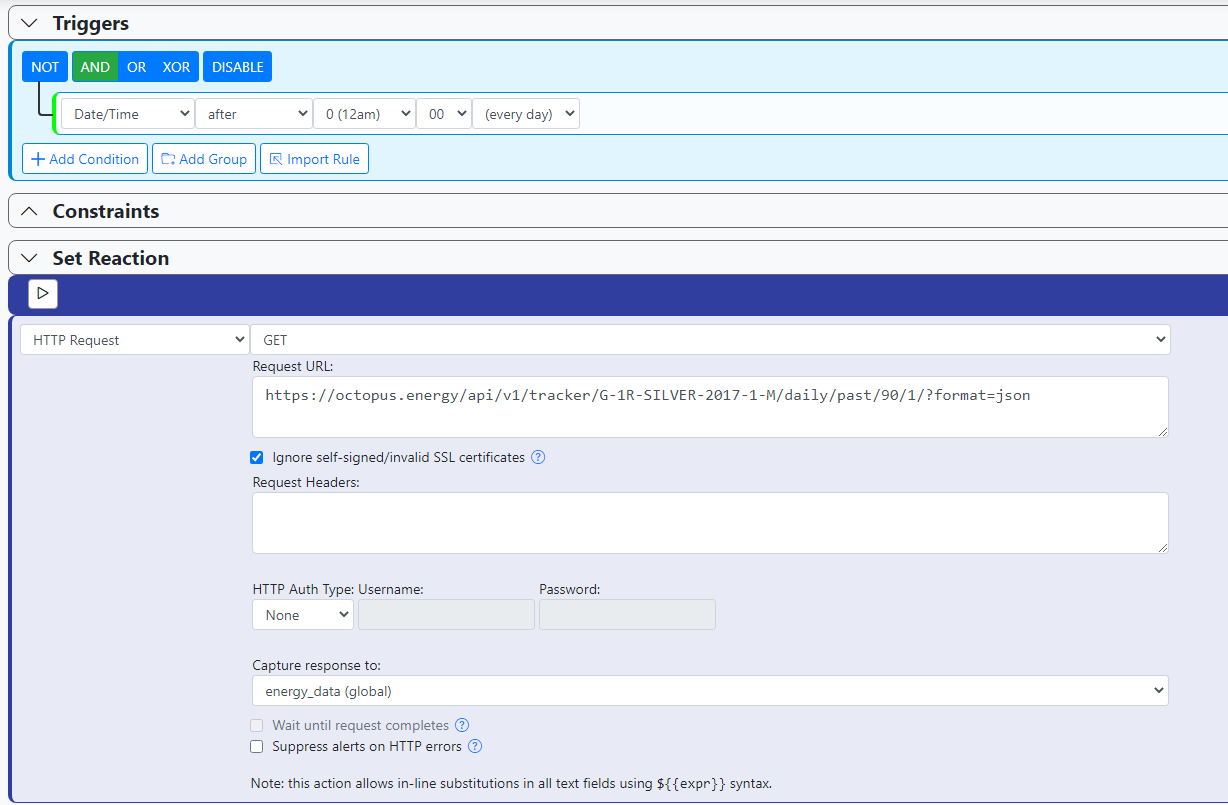
          I would first set up a Rule to query the server each day at a particular time. That rule would use an HTTP Request action to store the response into a global variable (let's call it energy_data). You need to create the global variable first, just leave the expression blank.

          Then make another global expression to fetch and hold the rate for today from the response by using the first statement to go through energy_data.periods until it finds the entry with date matching today's date... it would look something like this

          first entry in energy_data.periods with entry.date == strftime( "%F" ): entry.unit_rate
          

          (assuming unit_rate is the correct key/field in the entry; if not, just use the correct key name).

          You can then create whatever other rule you need based on the rate fetched.

          I tested this; works fine. Here's the rule that does the fetch every day at midnight:
          f3f53e15-8289-4b02-a399-82f6738640a5-image.png

          And here is what the expressions look like:

          31e9b926-ba4c-4812-a6cd-f4720ba723eb-image.png

          You will also need to set http_request_action_maxresponse in the engine section of your reactor.yaml file to a value large enough to contain the result. I just set it to 256 (units are kilobytes). It appears that the structure of the URL may offer some control over the number of entries returned, so you might consider using that to reduce the overhead.

          Edit: sure enough, if you change the "90" in the URL to a smaller number, it returns that many days of info, so use something like 7 and you'll reduce the query overhead considerably. You really only need today's anyway, right? (so maybe even 1 or 2 would work?)

          Author of Multi-system Reactor and Reactor, DelayLight, Switchboard, and about a dozen other plugins that run on Vera and openLuup.

          T 1 Reply Last reply
          0
          • toggledbitsT toggledbits

            @talisker That's JSON. It's doable, but not trivial for the new players.

            I would first set up a Rule to query the server each day at a particular time. That rule would use an HTTP Request action to store the response into a global variable (let's call it energy_data). You need to create the global variable first, just leave the expression blank.

            Then make another global expression to fetch and hold the rate for today from the response by using the first statement to go through energy_data.periods until it finds the entry with date matching today's date... it would look something like this

            first entry in energy_data.periods with entry.date == strftime( "%F" ): entry.unit_rate
            

            (assuming unit_rate is the correct key/field in the entry; if not, just use the correct key name).

            You can then create whatever other rule you need based on the rate fetched.

            I tested this; works fine. Here's the rule that does the fetch every day at midnight:

            f3f53e15-8289-4b02-a399-82f6738640a5-image.png

            And here is what the expressions look like:

            31e9b926-ba4c-4812-a6cd-f4720ba723eb-image.png

            You will also need to set http_request_action_maxresponse in the engine section of your reactor.yaml file to a value large enough to contain the result. I just set it to 256 (units are kilobytes). It appears that the structure of the URL may offer some control over the number of entries returned, so you might consider using that to reduce the overhead.

            Edit: sure enough, if you change the "90" in the URL to a smaller number, it returns that many days of info, so use something like 7 and you'll reduce the query overhead considerably. You really only need today's anyway, right? (so maybe even 1 or 2 would work?)

            T Offline
            T Offline
            Talisker
            wrote on last edited by
            #5

            @toggledbits thank you once again! Very clear instructions. I am now up an running and have opened up new opportunites to extend my automation.

            MSR user on Raspberry PI 4. Running MSR version 26011 in Docker

            1 Reply Last reply
            1
            • tunnusT tunnus referenced this topic on
            • T Offline
              T Offline
              Talisker
              wrote on last edited by Talisker
              #6

              I have made an http request and get the following JSON response which I have stored in a global variable gas_consumption (like the example above). See below.

              I have then tried to the following expression to extract the consumption value:
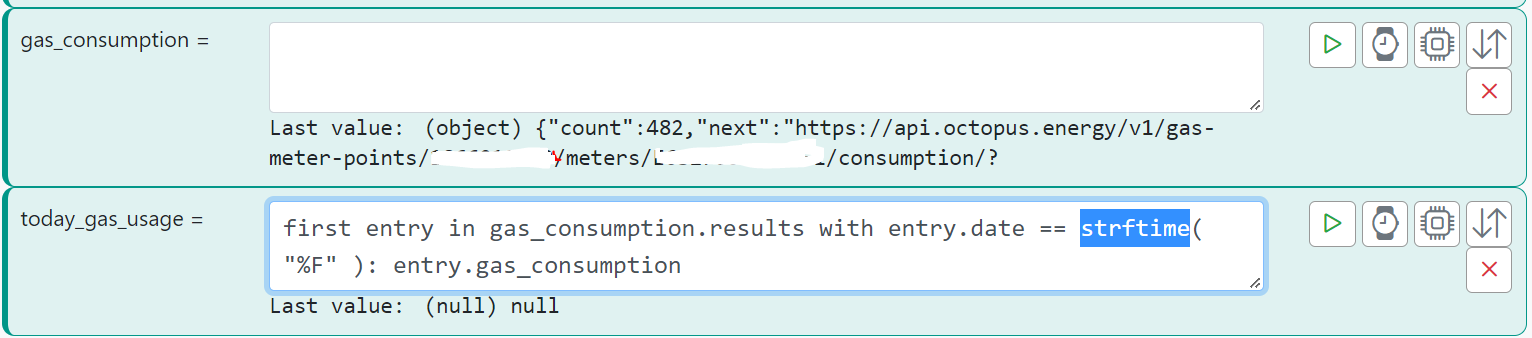
              0818a20e-2700-4a4c-a9be-47a64f452051-image.png

              Clearly the returned data "results" is not published for today (strftime( "%F) i.e. 4/9/2022.

              How do I extract the gas consumption for a particular date?
              How do I extract yesterday's gas consumption (in the case of the response below 3/9/2022)?

              ===group

              {
              	"count": 482,
              	"next": "https://api.octopus.energy/v1/gas-meter-points/xxxxxxxxxxx/meters/xxxxxxxxxxx/consumption/?format=json&group_by=day&page=2&page_size=10",
              	"previous": null,
              	"results": [{
              		"consumption": 0.0,
              		"interval_start": "2022-09-03T00:00:00+01:00",
              		"interval_end": "2022-09-03T01:00:00+01:00"
              	}, {
              		"consumption": 1.077,
              		"interval_start": "2022-09-02T00:00:00+01:00",
              		"interval_end": "2022-09-03T00:00:00+01:00"
              	}, {
              		"consumption": 0.669,
              		"interval_start": "2022-09-01T00:00:00+01:00",
              		"interval_end": "2022-09-02T00:00:00+01:00"
              	}, {
              		"consumption": 0.761,
              		"interval_start": "2022-08-31T00:00:00+01:00",
              		"interval_end": "2022-09-01T00:00:00+01:00"
              	}, {
              		"consumption": 0.614,
              		"interval_start": "2022-08-30T01:00:00+01:00",
              		"interval_end": "2022-08-31T00:00:00+01:00"
              	}, {
              		"consumption": 0.0,
              		"interval_start": "2022-08-29T00:00:00+01:00",
              		"interval_end": "2022-08-29T01:00:00+01:00"
              	}, {
              		"consumption": 0.569,
              		"interval_start": "2022-08-28T00:00:00+01:00",
              		"interval_end": "2022-08-29T00:00:00+01:00"
              	}, {
              		"consumption": 0.0,
              		"interval_start": "2022-08-27T00:00:00+01:00",
              		"interval_end": "2022-08-28T00:00:00+01:00"
              	}, {
              		"consumption": 0.455,
              		"interval_start": "2022-08-26T00:00:00+01:00",
              		"interval_end": "2022-08-27T00:00:00+01:00"
              	}, {
              		"consumption": 0.681,
              		"interval_start": "2022-08-25T00:00:00+01:00",
              		"interval_end": "2022-08-26T00:00:00+01:00"
              	}]
              }
              
              ===

              MSR user on Raspberry PI 4. Running MSR version 26011 in Docker

              T 1 Reply Last reply
              0
              • toggledbitsT Offline
                toggledbitsT Offline
                toggledbits
                wrote on last edited by toggledbits
                #7

                You are on the right track. The problem with what you are doing is:

                1. Your are comparing entry.date in the loop, but date is not a field in those structures. I believe you mean to use interval_start. Also, gas_consumption used to get the result is not the correct name/key either.
                2. If you were to create a separate test variable using strftime("%F") as the entirety of its expression, I think you will quickly see the problem with the value being generated vs what you are trying to compare it to. I've done that below. See the problem? I'll leave it to you for the moment to come up with a fix.

                8985d2ac-5dbc-4088-9f27-f2799bf12a90-image.png

                Author of Multi-system Reactor and Reactor, DelayLight, Switchboard, and about a dozen other plugins that run on Vera and openLuup.

                1 Reply Last reply
                0
                • T Talisker

                  I have made an http request and get the following JSON response which I have stored in a global variable gas_consumption (like the example above). See below.

                  I have then tried to the following expression to extract the consumption value:

                  0818a20e-2700-4a4c-a9be-47a64f452051-image.png

                  Clearly the returned data "results" is not published for today (strftime( "%F) i.e. 4/9/2022.

                  How do I extract the gas consumption for a particular date?
                  How do I extract yesterday's gas consumption (in the case of the response below 3/9/2022)?

                  ===group

                  {
                  	"count": 482,
                  	"next": "https://api.octopus.energy/v1/gas-meter-points/xxxxxxxxxxx/meters/xxxxxxxxxxx/consumption/?format=json&group_by=day&page=2&page_size=10",
                  	"previous": null,
                  	"results": [{
                  		"consumption": 0.0,
                  		"interval_start": "2022-09-03T00:00:00+01:00",
                  		"interval_end": "2022-09-03T01:00:00+01:00"
                  	}, {
                  		"consumption": 1.077,
                  		"interval_start": "2022-09-02T00:00:00+01:00",
                  		"interval_end": "2022-09-03T00:00:00+01:00"
                  	}, {
                  		"consumption": 0.669,
                  		"interval_start": "2022-09-01T00:00:00+01:00",
                  		"interval_end": "2022-09-02T00:00:00+01:00"
                  	}, {
                  		"consumption": 0.761,
                  		"interval_start": "2022-08-31T00:00:00+01:00",
                  		"interval_end": "2022-09-01T00:00:00+01:00"
                  	}, {
                  		"consumption": 0.614,
                  		"interval_start": "2022-08-30T01:00:00+01:00",
                  		"interval_end": "2022-08-31T00:00:00+01:00"
                  	}, {
                  		"consumption": 0.0,
                  		"interval_start": "2022-08-29T00:00:00+01:00",
                  		"interval_end": "2022-08-29T01:00:00+01:00"
                  	}, {
                  		"consumption": 0.569,
                  		"interval_start": "2022-08-28T00:00:00+01:00",
                  		"interval_end": "2022-08-29T00:00:00+01:00"
                  	}, {
                  		"consumption": 0.0,
                  		"interval_start": "2022-08-27T00:00:00+01:00",
                  		"interval_end": "2022-08-28T00:00:00+01:00"
                  	}, {
                  		"consumption": 0.455,
                  		"interval_start": "2022-08-26T00:00:00+01:00",
                  		"interval_end": "2022-08-27T00:00:00+01:00"
                  	}, {
                  		"consumption": 0.681,
                  		"interval_start": "2022-08-25T00:00:00+01:00",
                  		"interval_end": "2022-08-26T00:00:00+01:00"
                  	}]
                  }
                  
                  ===
                  T Offline
                  T Offline
                  Talisker
                  wrote on last edited by
                  #8

                  Background to the question
                  I've been experimenting a little and I need help. If I use the following expression:

                  03c304e5-fbfb-4895-9147-7ef0ea1d6592-image.png

                  I get the correct response (i.e. today's day number '16'th).

                  I can use this in a HTTP requst to download some tarrif information via an API from my energy supplier - i.e. today's gas unit rate tariff

                  What I'd like to do

                  I would like to download tomorrow's gas unit rate tariff. To do this I need to set up and expression with today's date + 1 day (in the case of my example expression above that would be '17' (today being the 16th).

                  Question: How do I take today's date and add 1 day - so that I can make the HTTP request for tomorrow's information?

                  Any guidance or suggestions would be appreciated.

                  MSR user on Raspberry PI 4. Running MSR version 26011 in Docker

                  1 Reply Last reply
                  0
                  • toggledbitsT Offline
                    toggledbitsT Offline
                    toggledbits
                    wrote on last edited by
                    #9

                    Read the docs for Expressions (the Date/Time handling section in particular) and familiarize yourself with the tools available. I'll give you a couple of pointers:

                    The time() function can take arguments in several forms to build any reasonable date. The dateparts() function will return any timestamp or the current time/date as its components (hour, minute, year, month, day, etc., and better than using strftime() for the purpose).

                    Special hint: if you tell time() to make a timestamp for July 32, 2022, it will give you a timestamp for August 1, 2022 without complaint.

                    Author of Multi-system Reactor and Reactor, DelayLight, Switchboard, and about a dozen other plugins that run on Vera and openLuup.

                    T 1 Reply Last reply
                    1
                    • toggledbitsT toggledbits

                      Read the docs for Expressions (the Date/Time handling section in particular) and familiarize yourself with the tools available. I'll give you a couple of pointers:

                      The time() function can take arguments in several forms to build any reasonable date. The dateparts() function will return any timestamp or the current time/date as its components (hour, minute, year, month, day, etc., and better than using strftime() for the purpose).

                      Special hint: if you tell time() to make a timestamp for July 32, 2022, it will give you a timestamp for August 1, 2022 without complaint.

                      T Offline
                      T Offline
                      Talisker
                      wrote on last edited by
                      #10

                      @toggledbits Thanks for the prompts, following which I made some progress:
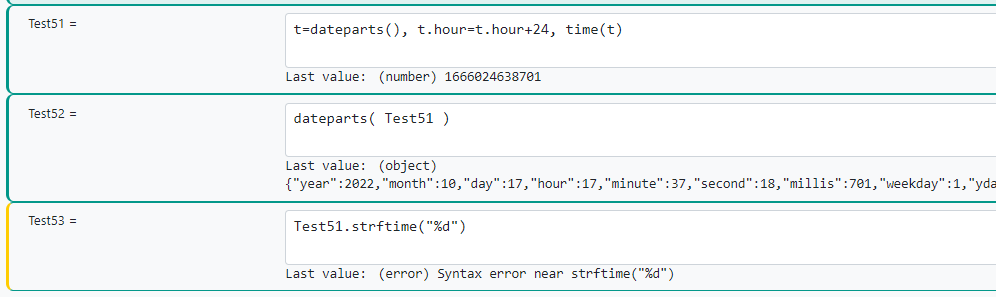
                      6f968ae5-b0b6-4d54-9b46-6441c90cf73e-image.png

                      I have Test51 which contains tomorrow's date, but I am struggling to get the time in a sting representation. I am trying to represent the day in Test53 expression but I have a syntax error.

                      I would appreciate some more guidance.

                      MSR user on Raspberry PI 4. Running MSR version 26011 in Docker

                      1 Reply Last reply
                      1
                      • toggledbitsT Offline
                        toggledbitsT Offline
                        toggledbits
                        wrote on last edited by toggledbits
                        #11

                        THAT is the proper use of strftime(). The time is the (optional) second argument (i.e. you don't write Test53.strftime(...), you write strftime( "%F %T", Test53)). Again, read the docs. strftime() is a Reactor-specific function, documented lower down on the page.

                        Edit: specific correction for clarity.

                        Author of Multi-system Reactor and Reactor, DelayLight, Switchboard, and about a dozen other plugins that run on Vera and openLuup.

                        T 1 Reply Last reply
                        0
                        • toggledbitsT toggledbits

                          THAT is the proper use of strftime(). The time is the (optional) second argument (i.e. you don't write Test53.strftime(...), you write strftime( "%F %T", Test53)). Again, read the docs. strftime() is a Reactor-specific function, documented lower down on the page.

                          Edit: specific correction for clarity.

                          T Offline
                          T Offline
                          Talisker
                          wrote on last edited by
                          #12

                          @toggledbits Thanks for your pointers. Partial success:

                          6df6b31f-039d-4fd6-9c8d-15784218cbe4-image.png

                          However, the expressions do not update! I use Tomorrow_Date in a Rule (HTTP Request):

                          https://api.octopus.energy/v1/products/SILVER-22-04-25/gas-tariffs/G-1R-SILVER-22-04-25-M/standard-unit-rates/?page_size=10&period_from=https://api.octohttps://api.octopus.energy/v1/products/SILVER-22-04-25/gas-tariffs/G-1R-SILVER-22-04-25-M/standard-unit-rates/?page_size=10&period_from=**${{Tomorrow_Date}}**&order_by=period

                          Is there a way to force an update on selected expressions, say at a set time every day?

                          MSR user on Raspberry PI 4. Running MSR version 26011 in Docker

                          1 Reply Last reply
                          0
                          • toggledbitsT Offline
                            toggledbitsT Offline
                            toggledbits
                            wrote on last edited by
                            #13

                            Can you show your rule?

                            Author of Multi-system Reactor and Reactor, DelayLight, Switchboard, and about a dozen other plugins that run on Vera and openLuup.

                            T 1 Reply Last reply
                            0
                            • toggledbitsT toggledbits

                              Can you show your rule?

                              T Offline
                              T Offline
                              Talisker
                              wrote on last edited by
                              #14

                              @toggledbits 2aae465d-b404-43f1-babe-0f12435a73eb-image.png

                              No Reset Reaction or Local Expressions are set.

                              The request URL is:
                              https://api.octopus.energy/v1/products/SILVER-22-04-25/gas-tariffs/G-1R-SILVER-22-04-25-M/standard-unit-rates/?page_size=10&period_from=https://api.octohttps://api.octopus.energy/v1/products/SILVER-22-04-25/gas-tariffs/G-1R-SILVER-22-04-25-M/standard-unit-rates/?page_size=10&period_from=${{Tomorrow_Date}}&order_by=period

                              MSR user on Raspberry PI 4. Running MSR version 26011 in Docker

                              1 Reply Last reply
                              0
                              • toggledbitsT Offline
                                toggledbitsT Offline
                                toggledbits
                                wrote on last edited by
                                #15

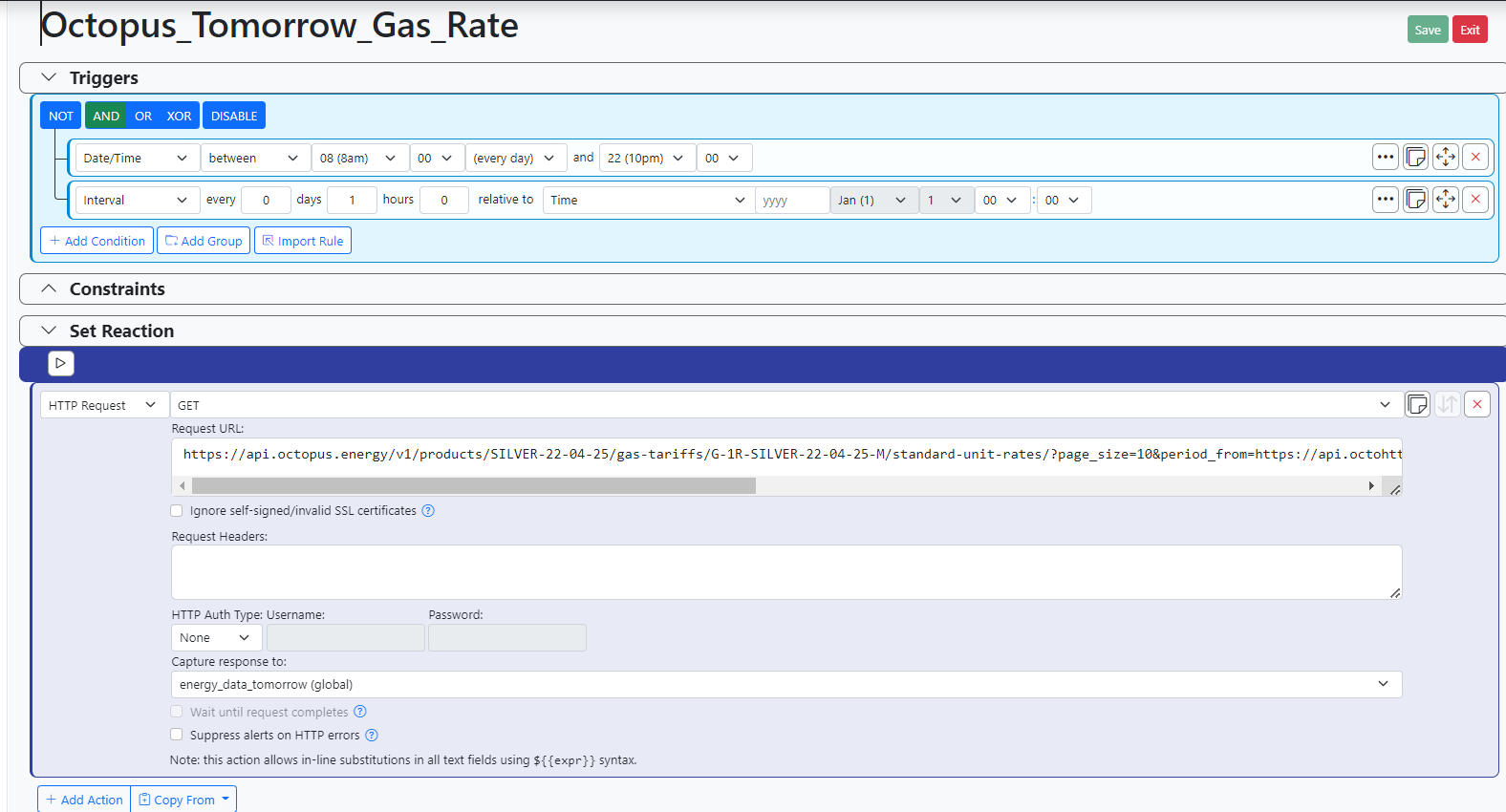
                                OK. Move your global expressions into your rule so they are rule-based expressions. They will update each time the Interval triggers.
                                Author of Multi-system Reactor and Reactor, DelayLight, Switchboard, and about a dozen other plugins that run on Vera and openLuup.

                                1 Reply Last reply
                                0
                                Reply
                                • Reply as topic
                                Log in to reply
                                • Oldest to Newest
                                • Newest to Oldest
                                • Most Votes


                                Recent Topics

                                • DynamicGroupController and attributes
                                  toggledbitsT
                                  toggledbits
                                  1
                                  4
                                  21

                                • Arming Envisalink panel from MSR
                                  toggledbitsT
                                  toggledbits
                                  0
                                  5
                                  41

                                • Upgrade Issues
                                  T
                                  tbully
                                  0
                                  9
                                  153

                                • [SOLVED] Conflicting Set Reaction Groups Appear to Fire Simultaneously in Single Rule Evaluation
                                  toggledbitsT
                                  toggledbits
                                  0
                                  10
                                  136

                                • [SOLVED] Question regarding "in" vs "contains" vs contents of the string
                                  G
                                  gwp1
                                  0
                                  5
                                  64

                                • Reactor (Multi-System/Multi-Hub) Announcements
                                  toggledbitsT
                                  toggledbits
                                  5
                                  147
                                  128.0k

                                • openLuup console disappeared - 500 - Internal Server Error
                                  A
                                  a-lurker
                                  0
                                  2
                                  152

                                • Logon screen timeout
                                  G
                                  gwp1
                                  0
                                  5
                                  177

                                • [MSR] Copy&past of actions and/or drag&drop between set/reset
                                  toggledbitsT
                                  toggledbits
                                  0
                                  9
                                  329

                                • Upgrade advice - upgrade from aarch64 to ARM64 image
                                  toggledbitsT
                                  toggledbits
                                  0
                                  4
                                  192

                                • Alexa for MSR, any interest?
                                  CatmanV2C
                                  CatmanV2
                                  2
                                  4
                                  327
                                Powered by NodeBB | Contributors
                                Hosted freely by 10RUPTiV - Solutions Technologiques | Contact us
                                • Login

                                • Don't have an account? Register

                                • Login or register to search.
                                • First post
                                  Last post
                                0
                                • Categories
                                • Recent
                                • Tags
                                • Popular
                                • Unsolved