





Multidimensional Array
-
The recommended debugging for this would be to start unraveling your criteria and see what it produces. As a first step (don't do this, just read), I would remove the
filter_expressionand make sure that your selectors are producing the expected set of eligible devices. An easy way to do that is to simply put an "X" in front offilter_expression(i.e. to make itXfilter_expression), which changes the name of the key and hides it from the code that's looking for it. You could also comment it out, but that would require that you comment each subordinate line as well, which is more work and can be error-prone. Restart MSR after config changes, of course, and refreshes are also recommended (don't need to be hard refreshes).But, I found an error, and it's pretty subtle. For me, it logged one short line, so it would be easy to miss; I imagine you have it as well. But it's going to require a code change to fix, so I'll release another build later today. I'll also fix the doc issue you PM'd me about.
Also, don't forget that filtering by controller or capability is a good way to quickly remove "noise" from your Entities list.
I debugged removing filter_axpression entirely, and the variables are still empty. I'll wait for your version update and test again.
-
The recommended debugging for this would be to start unraveling your criteria and see what it produces. As a first step (don't do this, just read), I would remove the
filter_expressionand make sure that your selectors are producing the expected set of eligible devices. An easy way to do that is to simply put an "X" in front offilter_expression(i.e. to make itXfilter_expression), which changes the name of the key and hides it from the code that's looking for it. You could also comment it out, but that would require that you comment each subordinate line as well, which is more work and can be error-prone. Restart MSR after config changes, of course, and refreshes are also recommended (don't need to be hard refreshes).But, I found an error, and it's pretty subtle. For me, it logged one short line, so it would be easy to miss; I imagine you have it as well. But it's going to require a code change to fix, so I'll release another build later today. I'll also fix the doc issue you PM'd me about.
Also, don't forget that filtering by controller or capability is a good way to quickly remove "noise" from your Entities list.
@toggledbits well done
Low Battery Devices charging perfect!
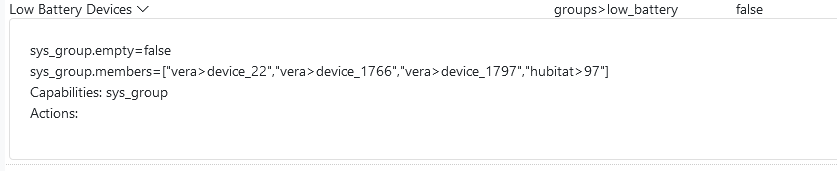
But there is a problem for "tripped", which repeated the same setting as "low_battery".
  - id: groups
    enable: true
    implementation: DynamicGroupController
    name: Dynamic Group Controller
    config:
      groups:
        "low_battery":
          name: Low Battery Devices
          select:
            - include_capability:
              - battery_power
          filter_expression: >
            entity.attributes.battery_power.level < 0.3
        "tripped":
          name: Tripped Devices
          select:
            - include_capability:
              - binary_sensor
              - motion_sensor
          filter_expression: >
            entity.attributes.binary_sensor.state == true or
            entity.attributes.motion_sensor.state == true
This is what is showing up in the log.
[latest-21332]2021-11-29T01:49:33.599Z <default:ERR> error updating dynamic group tripped: ReferenceError: Invalid reference to member state of null
[latest-21332]2021-11-29T01:49:33.600Z <default:CRIT> ReferenceError: Invalid reference to member state of null
ReferenceError: Invalid reference to member state of null
    at _run (C:\MSR\reactor\common\lexp.js:1369:31)
    at _run (C:\MSR\reactor\common\lexp.js:1233:34)
    at _run (C:\MSR\reactor\common\lexp.js:1290:44)
    at C:\MSR\reactor\common\lexp.js:1223:29
    at Array.forEach (<anonymous>)
    at _run (C:\MSR\reactor\common\lexp.js:1222:28)
    at Object.run (C:\MSR\reactor\common\lexp.js:1564:22)
    at DynamicGroupController._update_group (C:\MSR\reactor\server\lib\DynamicGroupController.js:229:141)
    at C:\MSR\reactor\server\lib\DynamicGroupController.js:267:39
    at Array.forEach (<anonymous>)
Would I have to include any additional information in the configuration to not have this problem with null?
-
In your expression, you are not guarding for entities that have
binary_sensorbut do not havemotion_sensor, and vice versa. Use the coalescing member access operator?.in the two sub-expressions.Author of Multi-system Reactor and Reactor, DelayLight, Switchboard, and about a dozen other plugins that run on Vera and openLuup.
-
In your expression, you are not guarding for entities that have
binary_sensorbut do not havemotion_sensor, and vice versa. Use the coalescing member access operator?.in the two sub-expressions.Perfect, solved, after putting the ?. in several places until I discovered how to use it correctly

        "tripped":
          name: Tripped Devices
          select:
            - include_capability:
              - binary_sensor
              - motion_sensor
          filter_expression: >
            entity.attributes?.binary_sensor?.state == true or
            entity.attributes?.motion_sensor?.state == true
Boss, this thread started because I want to associate to each device an information of which group it would belong inside my system, external information that I will have to prepare manually, we started with the array, then we went to object, until you announce this new function.
What is the way now? At this moment my progress is to have in a more simplified way the ID of the devices that will understand a condition, now how in the case of Tripped I will be able to associate to the groups, the list assembled before? I already saw that I can have a global variable with the information, that this Dynamic instruction by the manual will be able to read.
Could you put together an example please?
Thanks.
-
Perfect, solved, after putting the ?. in several places until I discovered how to use it correctly
        "tripped":
          name: Tripped Devices
          select:
            - include_capability:
              - binary_sensor
              - motion_sensor
          filter_expression: >
            entity.attributes?.binary_sensor?.state == true or
            entity.attributes?.motion_sensor?.state == true
Boss, this thread started because I want to associate to each device an information of which group it would belong inside my system, external information that I will have to prepare manually, we started with the array, then we went to object, until you announce this new function.
What is the way now? At this moment my progress is to have in a more simplified way the ID of the devices that will understand a condition, now how in the case of Tripped I will be able to associate to the groups, the list assembled before? I already saw that I can have a global variable with the information, that this Dynamic instruction by the manual will be able to read.
Could you put together an example please?
Thanks.
@wmarcolin said in Multidimensional Array:
this thread started because I want to associate to each device an information of which group it would belong inside my system, external information that I will have to prepare manually
You still haven't stated why you want to do this, so in my view, we're on the Y of an X-Y problem. What you are asking seems an odd thing to do... error-prone, laborious, hard to maintain. If I understood why you think you need to do it, we might arrive at a better solution that works from existing functionality, or a clear requirement for a new feature. When I asked before for this clarification (and repair of the topic title), you replied with a restatement of your implementation question, not an explanation of the problem you are trying to solve (i.e. why you want to do the implementation you are asking about), just as you've again done now.
If I ask you how to ventilate an enclosed space that has small windows and a doorway that is usually left open, given no other information, what might you suggest?
Would you answer differently if I also told you in advance that the space will be a new module for the International Space Station?
Author of Multi-system Reactor and Reactor, DelayLight, Switchboard, and about a dozen other plugins that run on Vera and openLuup.
-
@wmarcolin said in Multidimensional Array:
this thread started because I want to associate to each device an information of which group it would belong inside my system, external information that I will have to prepare manually
You still haven't stated why you want to do this, so in my view, we're on the Y of an X-Y problem. What you are asking seems an odd thing to do... error-prone, laborious, hard to maintain. If I understood why you think you need to do it, we might arrive at a better solution that works from existing functionality, or a clear requirement for a new feature. When I asked before for this clarification (and repair of the topic title), you replied with a restatement of your implementation question, not an explanation of the problem you are trying to solve (i.e. why you want to do the implementation you are asking about), just as you've again done now.
If I ask you how to ventilate an enclosed space that has small windows and a doorway that is usually left open, given no other information, what might you suggest?
Would you answer differently if I also told you in advance that the space will be a new module for the International Space Station?
Ok, I will try to explain what I want to do.
When using Vera, I in the Dashboard > My Modes panel determined which devices could trigger the house alarm in a given mode. With the change to Hubitat has no equal to Vera, and also not wanting to depend on the hub anymore, I want to have total control of the situation.
I thought about creating device groups (yes manually for now), i.e.: door group, window group, motion sensors, sensors like CO and water, and devices that should alarm and are not in the other groups.
So when I activate for example the night mode I want to trigger the alarm if the devices that are in the door group are tripped. If I enter Away mode, I want to join the devices' doors, windows, and motion. In Vacation mode, I put everything together and monitor if any device is tripped to trigger the alarm.
Another example, I can put all the liquid sensor devices in a water detector group, so when I evaluate the rule I refer to the group, and not to each device. You could say more there, just see who has leak_detector_state, but as we discussed before there is no standard, remember the discussion of the binary_sensor standard?
Another situation we could put together, the same way I put the door and window group together in Away mode, I could use it to if nothing is tripped, allow the central air in the house to work.
Trying to make a summary is, in a single table (beginning of this thread), I determine which group the device belongs to and do actions by group and not having to identify each device, we can say that it would be the equivalent in Vera as category_num and subcategory_num, and again this is from Vera, and they made mistakes by not respecting the table they created and both icon and device behavior not working, but it was interesting the grouping table (http://wiki.micasaverde.com/index.php/Luup_Device_Categories).
That is why even in this thread I thought if there was a way to add a group attribute to the devices in the MSR table, and by a set variable align this information, it did not work because you explained that if it does not come from the hub, there is no way to load the information.
Did I succeed in explaining the scenario?
Where I am at this moment:
- I created the object as you taught:
DeviceList = {
"vera>device_489": {group:"Door"},
"vera>device_432": {group:"Door"},
"hubitat>99": {group: "Window"},
"hubitat>15": {group: "Window"},
"vera>device_1672": {group:"Sensor"},
"vera>device_1867": {group:"Sensor"},
"vera>device_22": {group: "Security"},
"vera>device_1679": {group:"Security"},
"hubitat>1": {group: "Security"},
"vera>device_1822": {group:"Security"}
} - Now with Dynamic I have it easy that it is tripped;
- I have a global variable that is loaded in each mode, DeviceAlarm, which is an object that I put who will be monitored in the activated mode, for example, set variable DeviceAlarm = ${{["Door", "Window"]}}.
What I don't know how to do now, I don't dominate the programming/language, is how to ask and/or put together Dynamic's tripped + DeviceList object + DeviceAlarm + Device name.
What do I look for? Who is Tripped (Dynamic Tripped), with the parameter filter (DeviceAlarm), in the device list (Object DeviceList)? Give me the device name in one variable, and a second variable the list of Groups that are tripped. In this second answer, I pass the list of what I want to look at in DeviceAlarm, but it should only return what is tripped.
Sorry for the bother, and you are right that I am joining topics from several different threads. I'm just trying to have something that could make the operation easier, and optimize the code in my view.
Thanks.
- I created the object as you taught:
-
Ok, I will try to explain what I want to do.
When using Vera, I in the Dashboard > My Modes panel determined which devices could trigger the house alarm in a given mode. With the change to Hubitat has no equal to Vera, and also not wanting to depend on the hub anymore, I want to have total control of the situation.
I thought about creating device groups (yes manually for now), i.e.: door group, window group, motion sensors, sensors like CO and water, and devices that should alarm and are not in the other groups.
So when I activate for example the night mode I want to trigger the alarm if the devices that are in the door group are tripped. If I enter Away mode, I want to join the devices' doors, windows, and motion. In Vacation mode, I put everything together and monitor if any device is tripped to trigger the alarm.
Another example, I can put all the liquid sensor devices in a water detector group, so when I evaluate the rule I refer to the group, and not to each device. You could say more there, just see who has leak_detector_state, but as we discussed before there is no standard, remember the discussion of the binary_sensor standard?
Another situation we could put together, the same way I put the door and window group together in Away mode, I could use it to if nothing is tripped, allow the central air in the house to work.
Trying to make a summary is, in a single table (beginning of this thread), I determine which group the device belongs to and do actions by group and not having to identify each device, we can say that it would be the equivalent in Vera as category_num and subcategory_num, and again this is from Vera, and they made mistakes by not respecting the table they created and both icon and device behavior not working, but it was interesting the grouping table (http://wiki.micasaverde.com/index.php/Luup_Device_Categories).
That is why even in this thread I thought if there was a way to add a group attribute to the devices in the MSR table, and by a set variable align this information, it did not work because you explained that if it does not come from the hub, there is no way to load the information.
Did I succeed in explaining the scenario?
Where I am at this moment:
- I created the object as you taught:
DeviceList = {
"vera>device_489": {group:"Door"},
"vera>device_432": {group:"Door"},
"hubitat>99": {group: "Window"},
"hubitat>15": {group: "Window"},
"vera>device_1672": {group:"Sensor"},
"vera>device_1867": {group:"Sensor"},
"vera>device_22": {group: "Security"},
"vera>device_1679": {group:"Security"},
"hubitat>1": {group: "Security"},
"vera>device_1822": {group:"Security"}
} - Now with Dynamic I have it easy that it is tripped;
- I have a global variable that is loaded in each mode, DeviceAlarm, which is an object that I put who will be monitored in the activated mode, for example, set variable DeviceAlarm = ${{["Door", "Window"]}}.
What I don't know how to do now, I don't dominate the programming/language, is how to ask and/or put together Dynamic's tripped + DeviceList object + DeviceAlarm + Device name.
What do I look for? Who is Tripped (Dynamic Tripped), with the parameter filter (DeviceAlarm), in the device list (Object DeviceList)? Give me the device name in one variable, and a second variable the list of Groups that are tripped. In this second answer, I pass the list of what I want to look at in DeviceAlarm, but it should only return what is tripped.
Sorry for the bother, and you are right that I am joining topics from several different threads. I'm just trying to have something that could make the operation easier, and optimize the code in my view.
Thanks.
@wmarcolin Hubitat has modes, and it has the Hubitat Safety Monitor (HSM), both of which are supported by Reactor. HSM can set arming based on detection level, so it's worth looking into.
If you still want to keep it all off hub, I would simply make groups:
- door_sensors:
include_capability: door_sensor - leak_sensors:
include_capability: leak_detector - motion_sensors:
include_capability: motion_sensor
The create "tripped" versions of each:
- door_sensors_tripped:
include_group: door_sensors,filter_expr: entity.attributes.door_sensor.state - leak_sensors_tripped:
include_group: leak_sensors,filter_expr: entity.attributes.leak_detector.state - etc.
Creating these extra tripped groups does two things for you: (1) it isolates the expression to the capability, so you don't have to worry about
motion_sensor.statevsleak_detector.statewithin a single group, the group is homogenous; and (2) by segmenting the devices to type, you more easily make the conditions for what devices are active in what security mode.Then in your alarm rules for Night, Away, Vacation modes, you check if the tripped group for each group you are interested in for that mode is empty or not. So for Night, you would only be checking door_sensors_tripped, while for Away it will be the tripped door, window, and motion groups.
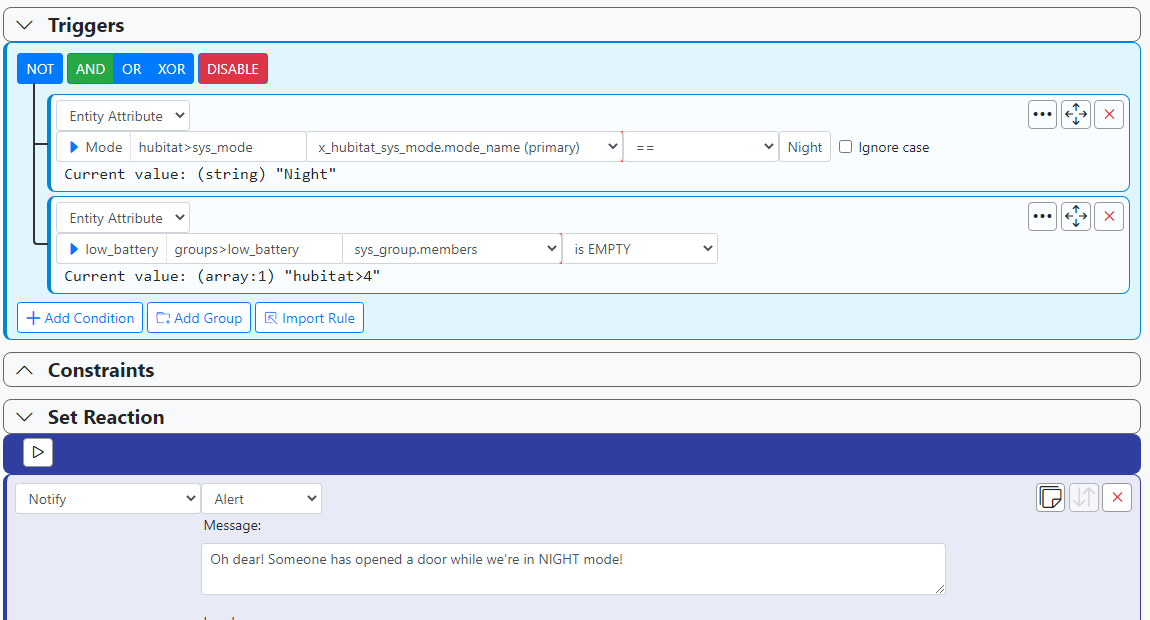
(ignore my group name -- I just picked a group I had to illustrate how the condition may be set up)
You don't need any variables at all (global or otherwise) to do what's described using dynamic groups.
Author of Multi-system Reactor and Reactor, DelayLight, Switchboard, and about a dozen other plugins that run on Vera and openLuup.
- I created the object as you taught:
-
@wmarcolin Hubitat has modes, and it has the Hubitat Safety Monitor (HSM), both of which are supported by Reactor. HSM can set arming based on detection level, so it's worth looking into.
If you still want to keep it all off hub, I would simply make groups:
- door_sensors:
include_capability: door_sensor - leak_sensors:
include_capability: leak_detector - motion_sensors:
include_capability: motion_sensor
The create "tripped" versions of each:
- door_sensors_tripped:
include_group: door_sensors,filter_expr: entity.attributes.door_sensor.state - leak_sensors_tripped:
include_group: leak_sensors,filter_expr: entity.attributes.leak_detector.state - etc.
Creating these extra tripped groups does two things for you: (1) it isolates the expression to the capability, so you don't have to worry about
motion_sensor.statevsleak_detector.statewithin a single group, the group is homogenous; and (2) by segmenting the devices to type, you more easily make the conditions for what devices are active in what security mode.Then in your alarm rules for Night, Away, Vacation modes, you check if the tripped group for each group you are interested in for that mode is empty or not. So for Night, you would only be checking door_sensors_tripped, while for Away it will be the tripped door, window, and motion groups.
(ignore my group name -- I just picked a group I had to illustrate how the condition may be set up)
You don't need any variables at all (global or otherwise) to do what's described using dynamic groups.
@toggledbits first of all thank you for the quick response, and this may be one way.
However (sorry), I see a disadvantage, we use the case of sensors with the attribute door_sensor they are valid for access doors to the house, but are also for windows (first and second floor of the house, and the second floor is not turned on in night mode), and the same attribute has the internal door sensors, which in this case I use for air conditioning management (open door turns off the air).
Another example would be the motion_sensor, I have internal and external sensors, in night mode the external ones turn on the garage and entrance lights, if I group everything by the attribute a movement inside the house would also trigger.
This way your proposal is very valid, but there should be a way to dismember the groups, i.e. door_sensors_group1 (external door), door_sensors_group2 (window 1), door_sensor_group3 (internal door).... that's why I thought about the table that could specify each device and not use an attribute that generalizes the devices.
This way your proposal is very valid, but there should be a way to dismember the groups, i.e. door_sensors_group1 (external door), door_sensors_group2 (window 1), door_sensor_group3 (internal door).... that's why I thought about the table that could specify each device and not use an attribute that generalizes the devices.
I don't know if there could be something in these instructions referring to the global object we commented on DeviceList.
door_sensors: include_capability: door_sensor %(#ff0000)[contained in DeviceList = "Door External".]
or would it be something in this instruction
door_sensors_tripped: include_group: door_sensors, filter_expr: entity.attributes.door_sensor.state %(#ff0000)[contained in DeviceList = "Door External".]
(please don't laugh at my coding, I said I don't know it))
The excellent thing is that we are going to take more automatic paths as you are commenting.
Despite not wanting to depend on a hub, I looked at the HSM option, I see that it would be possible to create the groups I have commented, now I did not understand your comment that the MSR would talk to the HSM.
In HSM the actions I see are alert by text, audio, siren or light. The way, in this case, would be to create a virtual device connected with HSM, and this one the MSR would monitor to take action?
In the Apps that I set up the MSR, I don't see the option to select on device the action I created in the HSM. I have the option Allow control of HSM activated. Do I have to configure anything to show up on the MSR?
Fact that I will not make Hubitat take action, who performs action in my solution is the MSR.
- door_sensors:
-
@toggledbits first of all thank you for the quick response, and this may be one way.
However (sorry), I see a disadvantage, we use the case of sensors with the attribute door_sensor they are valid for access doors to the house, but are also for windows (first and second floor of the house, and the second floor is not turned on in night mode), and the same attribute has the internal door sensors, which in this case I use for air conditioning management (open door turns off the air).
Another example would be the motion_sensor, I have internal and external sensors, in night mode the external ones turn on the garage and entrance lights, if I group everything by the attribute a movement inside the house would also trigger.
This way your proposal is very valid, but there should be a way to dismember the groups, i.e. door_sensors_group1 (external door), door_sensors_group2 (window 1), door_sensor_group3 (internal door).... that's why I thought about the table that could specify each device and not use an attribute that generalizes the devices.
This way your proposal is very valid, but there should be a way to dismember the groups, i.e. door_sensors_group1 (external door), door_sensors_group2 (window 1), door_sensor_group3 (internal door).... that's why I thought about the table that could specify each device and not use an attribute that generalizes the devices.
I don't know if there could be something in these instructions referring to the global object we commented on DeviceList.
door_sensors: include_capability: door_sensor %(#ff0000)[contained in DeviceList = "Door External".]
or would it be something in this instruction
door_sensors_tripped: include_group: door_sensors, filter_expr: entity.attributes.door_sensor.state %(#ff0000)[contained in DeviceList = "Door External".]
(please don't laugh at my coding, I said I don't know it))
The excellent thing is that we are going to take more automatic paths as you are commenting.
Despite not wanting to depend on a hub, I looked at the HSM option, I see that it would be possible to create the groups I have commented, now I did not understand your comment that the MSR would talk to the HSM.
In HSM the actions I see are alert by text, audio, siren or light. The way, in this case, would be to create a virtual device connected with HSM, and this one the MSR would monitor to take action?
In the Apps that I set up the MSR, I don't see the option to select on device the action I created in the HSM. I have the option Allow control of HSM activated. Do I have to configure anything to show up on the MSR?
Fact that I will not make Hubitat take action, who performs action in my solution is the MSR.
@wmarcolin said in Multidimensional Array:
I don't know if there could be something in these instructions referring to the global object we commented on DeviceList.
door_sensors: include_capability: door_sensor contained in DeviceList = "Door External".No, you can't refer to global variables in a group filter expression.
Make as many groups as you need/want.
@wmarcolin said in Multidimensional Array:
In the Apps that I set up the MSR, I don't see the option to select on device the action I created in the HSM. I have the option Allow control of HSM activated. Do I have to configure anything to show up on the MSR?
Find the entity called "Safety Monitor" in the Entities list (hint: use the filters; it will come from your Hubitat controller, and it will have capability
x_hubitat_hsm, as well as that very distinct name, so lots of ways to find it).Author of Multi-system Reactor and Reactor, DelayLight, Switchboard, and about a dozen other plugins that run on Vera and openLuup.
-
@wmarcolin said in Multidimensional Array:
I don't know if there could be something in these instructions referring to the global object we commented on DeviceList.
door_sensors: include_capability: door_sensor contained in DeviceList = "Door External".No, you can't refer to global variables in a group filter expression.
Make as many groups as you need/want.
@wmarcolin said in Multidimensional Array:
In the Apps that I set up the MSR, I don't see the option to select on device the action I created in the HSM. I have the option Allow control of HSM activated. Do I have to configure anything to show up on the MSR?
Find the entity called "Safety Monitor" in the Entities list (hint: use the filters; it will come from your Hubitat controller, and it will have capability
x_hubitat_hsm, as well as that very distinct name, so lots of ways to find it).Well, you put me to think a lot, I'm reviewing all the logic and I think progressing. You could have a video lesson on Creating Automations > Expressions
 I am looking to meet this with trial and error. I just tested this on Groups and it worked perfectly, it will help:
"internal_move": name: Internal Move Devices select: - include_entity: - "vera>device_1679" - "vera>device_1683" - "vera>device_1797" - "hubitat>1" - "hubitat>14" filter_expression: > entity.attributes?.motion_sensor?.state == trueNow from your last comment about the MSR visualizing the HSM, I really don't know what I have to do, the Safe Monitor you commented appears, but it is all Disarmed.

But in the HSM in the hub the rules are created, activated, and even with action alert activated.
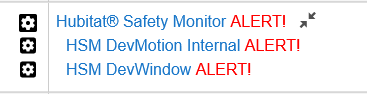
Any recommendations on what I should do?
Thanks,
-
 T toggledbits locked this topic on