






I updated to the latest version and it is working with Digest auth and the new username / password fields. You are going to spoil us with this pace of development 
A
Alan_F
@Alan_F
I'm trying to use MSR via reserve proxy in Synology DSM, but MSR page does not load
https://<public ip>:30000/reactor/en-US/
At the same time logging page loads normally
https://<public ip>:30000/api/v1/log
I thought maybe authentication was messing it up, but there was no deny entries in the log, and also disabling authentication did not make any difference. For this use case VPN is not an option (that works, but as said not an option for this particular use case).
Any ideas what could cause this? MSR build latest-26242-28d69aa8, Chrome browser
Build 21228 has been released. Docker images available from DockerHub as usual, and bare-metal packages here.
Home Assistant up to version 2021.8.6 supported; the online version of the manual will now state the current supported versions;
Fix an error in OWMWeatherController that could cause it to stop updating;
Unify the approach to entity filtering on all hub interface classes (controllers); this works for device entities only; it may be extended to other entities later;
Improve error detail in messages for EzloController during auth phase;
Add isRuleSet() and isRuleEnabled() functions to expressions extensions;
Implement set action for lock and passage capabilities (makes them more easily scriptable in some cases);
Fix a place in the UI where 24-hour time was not being displayed.
I may be late to the AI party on this, but I recently ran into difficulty installing and configuring the Nexia Thermostat Manager on my Hubitat C8 Pro. Hoping for some immediate help I performed a Google search on my problem. I was a bit surprised to see Gemini jump into assist. Gemini walked me through the steps to clean up the failed install, followed by a script for successful installation and configuration. I would not have expected Gemini to "know" this much about Hubitat. Next I sought assistance MSR with the Entity Actions needed to set up the desired controls. I was unclear which of the attribute fields I should to set the cooling an heating temperatures. Once again, Gemini came back not with just a link to a possible explanation, but an easy to follow explanation instead. Once again, I did not expect Gemini to provide such detailed assistance with MSR. Gemini will be a key tool in my HA toolkit in the future.
Nothing more to add. I see we have hvac_blower, but, anyway, maybe a native fan on the same assumptions of the fan from HASS could be reasonable.
I have a couple of them. ie, this is from ESPHome via HASS.
x_hass.domain="fan"
x_hass.entity_id="fan.kitchen_seashell_hood_ventilation_fan"
x_hass.floor_id=null
x_hass.services=["fan","esphome"]
x_hass.source="esphome"
x_hass.state="off"
x_hass_attr.friendly_name="Seashell Hood Ventilation Fan"
x_hass_attr.percentage=50
x_hass_attr.percentage_step=25
x_hass_attr.preset_mode=""
x_hass_attr.preset_modes=[]
x_hass_attr.supported_features=49
Thanks.
Build: latest-26221-b25bb3e3, Docker on Synology.
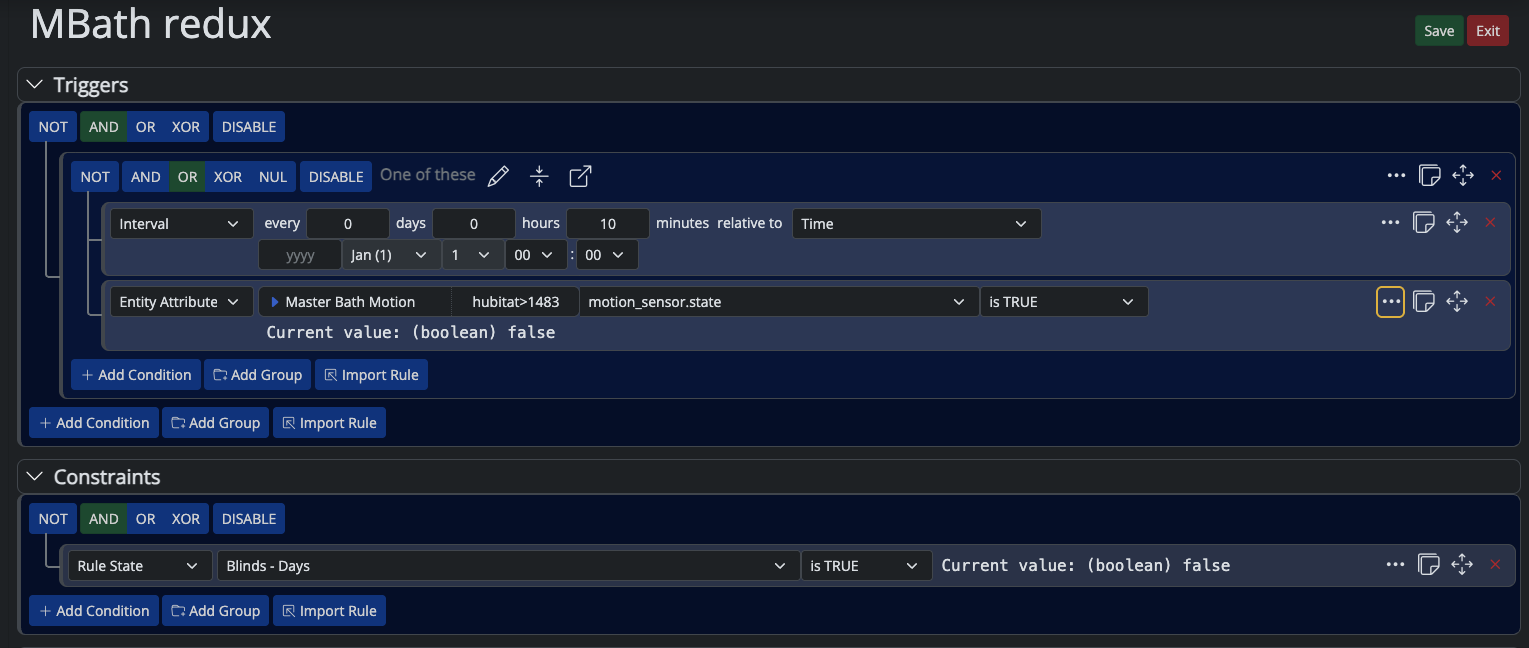
Hi, I have a Rule whose Trigger/Constraints reference other Rules via Rule State ... is TRUE. At some point it stops firing.
Expanding the rule's condition tree in the UI shows every Trigger and Constraint condition green/TRUE — confirmed live by walking into the room and watching Motion go true in real time. Rule History shows no new SET, just old reset entries.
Tried, on the same rule, same evening: recreating the trigger conditions with fresh IDs, recreating the constraint conditions with fresh IDs (flat and wrapped in a new Group — wrapping in a Group produced one SET, but it didn't reproduce on repeat attempts with the same structure), and finally a full container restart with a verified-correct saved rule. Still no SET, even with a fresh live motion event right after the restart.
Separately, I found that this rule (and its 10 per-room clones) share identical internal condition/group IDs with each other — leftover from a batch clone done months ago, never regenerated. Not sure if that's related, since fixing the IDs didn't reliably fix the symptom either.
Has anyone seen a Rule State condition show TRUE in the UI without the Rule ever producing a SET, surviving a clean restart?
Thanks in advance
Hey @toggledbits I'm back to trying to optimize a couple of things based on dynamic group.
First of all, I think I found a typo in the doc:
primary_attribute: "binary_sensor.state"
primary_attribute_value: |
d = false;
each id in members: d = getEntity(id)?.attributes?.power_switch?.state or d,
d
I think the correct code snippet is d = false,
All that said, my use case for dynamic groups is to group 3 different climate devices, so I could easily command them at the same time. Commands are good, but sometimes I want to check if any of the devices are on, and that's easily done with a similar snippet as the one you have in the docs. But this is limited to the primary attribute, while I want to have any of the attributes in the group to be driven by a similar logic (while all are null in the group). ie, access hvac_control.mode and see if any of the unit is set to cool, or heat. Is that possible, without re-defining an expression in each of my rules? Thanks!
As there are statements about compatibility for home assistant versions in MSR new version announcements (e.g. "HassController: Bless Hass to 2025.7.3"), I thought it would be good idea to track other controllers as well.
As an example, I can confirm that build "latest-25208-c53e8513" works with Hubitat Elevation C-8 platform version 2.4.2.134 using Maker API.
Updates: (the latest versions first in the list)
OK: build "latest-25264-2fbe9217" with Hubitat C-8 platform v. 2.4.3.123
Edit: Solved in latest-26221.
Bare-metal latest-26193
I have this group:
"OKforLarm":
name: OK för Larm
select:
- include_controller: vera
- include_capability: door_sensor
filter_expression: entity.attributes.door_sensor.state
It contains the entities I expect but behaves a bit odd. When I open vera>device_10097 the entity attribute door_sensor.state changes to true but it won't show up as member in the group, when I also open vera>device_10095 they both shows as members and when I close vera>device_10095 it disappear from the group but when I close vera>device_10097 it lingers in the group until I restart Reactor.
Love openLuup - it just keeps working perfectly.
I started looking at trying to add a gen4 Shelly device to the Shelly plugin via L_ShellyBridge.lua. The plugin is a little uncooked (no rudeness intended), so a bit of a rabbit hole for me.
All of a sudden no console pages available in either Firefox or Chrome. AltUI works perfectly and all the log files indicate no errors. openLuup still running everything works as it should - just no console pages.
I possibly screwed something up but any recently changes files show no problems. The original/ backup of L_ShellyBridge.lua was reinstated but still no console.
Bit stumped on this one. Not sure how to debug. Any ideas?
Posts
-
Having trouble with http and basic auth -
Difference between two dates.I'm still trying to try one of these things and not have @toggledbits come in right behind me and show a much easier way. Maybe this time I'll get lucky.
I came up with this:

-
Vera firmware 7.32 betaBased on the comments from the more experienced users here I ordered a Hubitat this morning and Amazon had it to my door about 3 hours later. After a few z-wave network resets to try to resolve one switch that just won't configure, I have about 90% of everything migrated over to Hubitat. Vera still has a few SiteSensors (I need to read up on the threads about replicating site sensors on MSR) and some Yeelight bulbs that are on a separate VLAN from the Hubitat. I haven't found a way to connect them manually yet and the Hubitat can't discover them across the VLANs.
I'm still trying to figure out a way to use Google Home to flip a virtual switch in Hubitat to then trigger a http call from MSR. There are a few things I was doing with Vera scenes to achieve a similar effect, but MSR doesn't seem to be able to see Hubitat virtual devices.
I'll probably keep the VeraPlus going for a while with the Yeelights and the SiteSensors while I figure the rest of this out.
Thanks for the advice.
-
Suppressing alerts in HTTP Request actions+1
I am getting occasional network timeouts on a http request that repeats every two minutes (it is emulating a SiteSensor that I had on Vera). I'd like to be able to suppress those alerts as they are expected to happen from time to time and not anything I need to be notified about.
Edit:
Nevermind.... I posted here before looking at the update you just posted in the announcements thread... I see you already made this change. -
Having trouble with http and basic authI took the UserName and Password, used a base 64 encoder and input "UserName:Password" into the encoder. I took the output of the encoder ("ABCDEFGXXX") and entered (no quotes) "Authentication: Basic ABCDEFGXXX" into the http headers field. I have another http request in another rule that hits an API to control my thermostat and it work correctly using exactly the same process.
The logs don't appear to make any reference to the http header:
[latest-21297]2021-11-01T22:21:55.816Z Engine:INFO Set PTZ Camera to Day Mode rule<SET> all actions completed.
[latest-21297]2021-11-01T22:21:55.845Z Engine:ERR Engine#1 reaction Set PTZ Camera to Day Mode rule<SET> step 3 HTTP request to http://xxx.xxx.xxx.xxx/cgi-bin/ptz.cgi?action=start&channel=0&code=GotoPreset&arg1=0&arg2=18&arg3=0 failed: 401 Unauthorized
[latest-21297]2021-11-01T22:21:55.854Z Engine:ERR Engine#1 reaction Set PTZ Camera to Day Mode rule<SET> step 1 HTTP request to http://xxx.xxx.xxx.xxx/cgi-bin/configManager.cgi?action=setConfig&VideoInMode[0].Config[0]=0 failed: 401 UnauthorizedPrior to attempting to use the http header field I had tried the below format, with the username and password in front of the URL:
[latest-21297]2021-11-01T12:58:08.125Z Engine:ERR Engine#1 reaction Set PTZ Camera to Night Mode rule<SET> step 3 HTTP request to http://UserName:Password@xxx.xxx.xxx.xxx/cgi-bin/configManager.cgi?action=setConfig&VideoInExposure[0][1].Value1=1000&VideoInExposure[0][1].Value2=1000 failed: 401 Unauthorized
I did get this working in Node-Red using digest authentication in a http-request node, so it probably isn't worth too much of everyone's time to track it down. I would prefer to have it in MSR because it is so much more user-friendly for me, but I can leave it in Node-Red if I can't figure out how to do it in MSR.
@toggledbits - Long overdue additional donation on its way. Thanks for all your efforts and the end-user support.
-
Notifications from AlertsResurrecting this older thread... does this answer mean there is no way to react to the presence of an alert within MSR? If not, this would be a useful enhancement.
I have a camera that is switched between day and night settings by http requests sent by MSR near sunset and sunrise. Yesterday the camera stayed in night mode most of the day while there was an alert showing in MSR that the http request had failed. I realize I could capture the http response to an expression/variable and then write a rule based on that variable to notify me, but I'd have to do this for every http request in every ruleset, and I'd have to make sure I evaluate the response correctly (which is likely to be a hit or miss operation for me). That still wouldn't capture other alerts that MSR might display outside of failed http requests, but I'd like to push all alerts to my notification system. Basically, I don't want to have to check the MSR interface to make sure it's happy, I'd like it to tell me when it's not.
-
Notifications from AlertsJust a note for posterity that alerts are now available as an entity as of version 21356.
-
Opening curtains with a motion sensor but only once?@cw-kid I'm sure there are multiple ways to do this, and probably some better than what I'm thinking...
Create an expression "g_curtains_open_today"
Create a rule. At midnight every day set g_curtains_open_today to false
Motion sensor rule: If motion sensor trips AND g_curtains_open_today is false then:
-> Open curtains
-> set g_curtains_open_today to trueThe next time the motion sensor trips before midnight the curtains will not open
-
MQTT - add rules support ?@Crille Thanks! I was a bit confused when I first read that section of the MQTT documentation but your example using the topics from my own system helped clear it up for me.
I made a slight change to the template to make it "teslamate/cars/%topic%" which allows me to re-use it for multiple binary entities for both cars by using for example "topic: "1/locked" and "topic: 2/locked" for two entities in reactor.yaml.
I also hit a snag where trying to directly copy:
    entities:
      teslamate_sensor:
        type: BinarySensor
        capabilities: ['binary_sensor']
        primary_attribute: binary_sensor.state
caused Reactor not to start with a yaml formatting error, but referring to the documentation I changed it to:
    entities:
      teslamate_sensor:
        type: BinarySensor
        capabilities:
          - binary_sensor
        primary_attribute: binary_sensor.state
moving the capability down one line with a leading "-" and it works.
Now I just have to find the time to write all the rules that are possible with the car information available in MSR...

-
General question: MSR and multiple HE hubsThey are not using the Hubitat mesh. They are completely separate.
-
Can the list of rule sets be sorted?So it works just like most of the other elements in MSR.
Move along people... nothing to see here... just me missing the obvious.