





Night and day difference for me. I think I was getting a lot of interference in my media closet. Devices were very slow to respond and sometimes not at all. Switched to UZB and used a USB extender to place it a good 5 ft from the location of my pi. Now things are fast and reliable.
K
kfxo
@kfxo
Build 21228 has been released. Docker images available from DockerHub as usual, and bare-metal packages here.
Home Assistant up to version 2021.8.6 supported; the online version of the manual will now state the current supported versions;
Fix an error in OWMWeatherController that could cause it to stop updating;
Unify the approach to entity filtering on all hub interface classes (controllers); this works for device entities only; it may be extended to other entities later;
Improve error detail in messages for EzloController during auth phase;
Add isRuleSet() and isRuleEnabled() functions to expressions extensions;
Implement set action for lock and passage capabilities (makes them more easily scriptable in some cases);
Fix a place in the UI where 24-hour time was not being displayed.
I'm trying to use MSR via reserve proxy in Synology DSM, but MSR page does not load
https://<public ip>:30000/reactor/en-US/
At the same time logging page loads normally
https://<public ip>:30000/api/v1/log
I thought maybe authentication was messing it up, but there was no deny entries in the log, and also disabling authentication did not make any difference. For this use case VPN is not an option (that works, but as said not an option for this particular use case).
Any ideas what could cause this? MSR build latest-26242-28d69aa8, Chrome browser
I may be late to the AI party on this, but I recently ran into difficulty installing and configuring the Nexia Thermostat Manager on my Hubitat C8 Pro. Hoping for some immediate help I performed a Google search on my problem. I was a bit surprised to see Gemini jump into assist. Gemini walked me through the steps to clean up the failed install, followed by a script for successful installation and configuration. I would not have expected Gemini to "know" this much about Hubitat. Next I sought assistance MSR with the Entity Actions needed to set up the desired controls. I was unclear which of the attribute fields I should to set the cooling an heating temperatures. Once again, Gemini came back not with just a link to a possible explanation, but an easy to follow explanation instead. Once again, I did not expect Gemini to provide such detailed assistance with MSR. Gemini will be a key tool in my HA toolkit in the future.
Nothing more to add. I see we have hvac_blower, but, anyway, maybe a native fan on the same assumptions of the fan from HASS could be reasonable.
I have a couple of them. ie, this is from ESPHome via HASS.
x_hass.domain="fan"
x_hass.entity_id="fan.kitchen_seashell_hood_ventilation_fan"
x_hass.floor_id=null
x_hass.services=["fan","esphome"]
x_hass.source="esphome"
x_hass.state="off"
x_hass_attr.friendly_name="Seashell Hood Ventilation Fan"
x_hass_attr.percentage=50
x_hass_attr.percentage_step=25
x_hass_attr.preset_mode=""
x_hass_attr.preset_modes=[]
x_hass_attr.supported_features=49
Thanks.
Build: latest-26221-b25bb3e3, Docker on Synology.
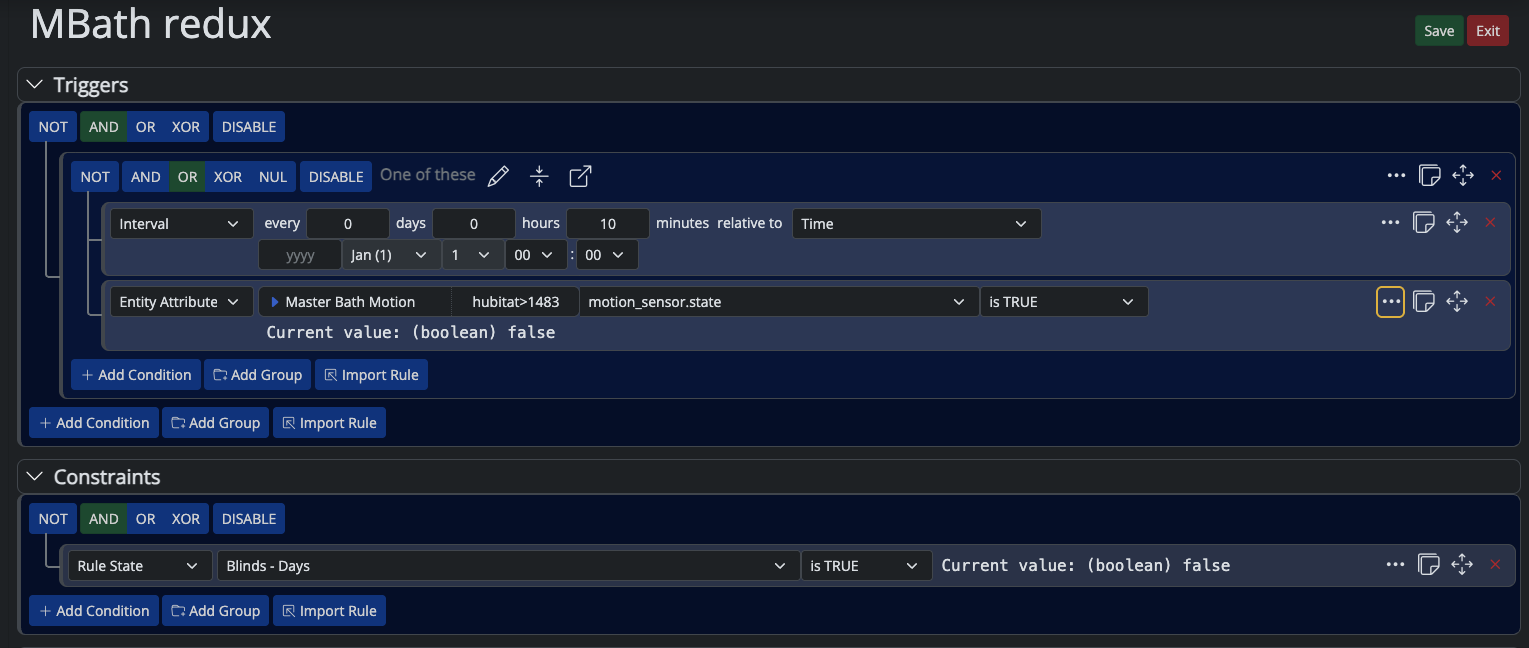
Hi, I have a Rule whose Trigger/Constraints reference other Rules via Rule State ... is TRUE. At some point it stops firing.
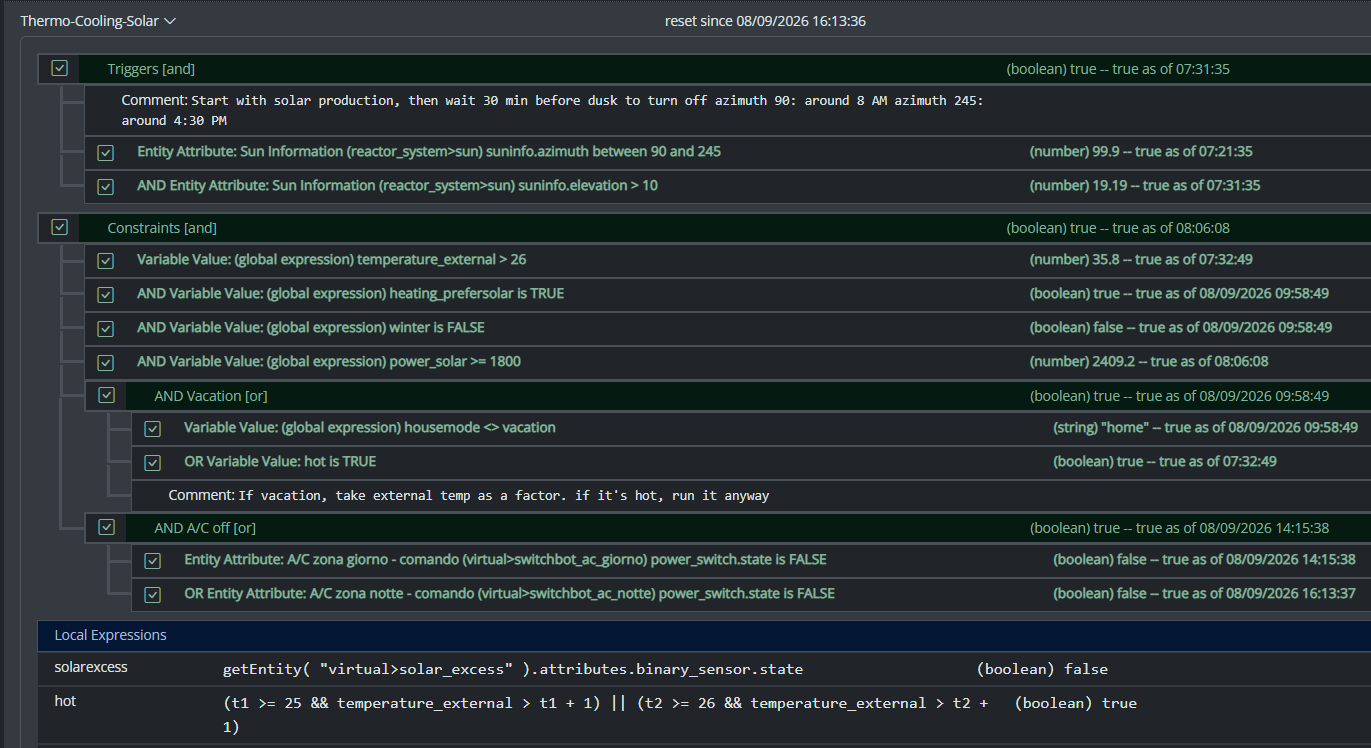
Expanding the rule's condition tree in the UI shows every Trigger and Constraint condition green/TRUE — confirmed live by walking into the room and watching Motion go true in real time. Rule History shows no new SET, just old reset entries.
Tried, on the same rule, same evening: recreating the trigger conditions with fresh IDs, recreating the constraint conditions with fresh IDs (flat and wrapped in a new Group — wrapping in a Group produced one SET, but it didn't reproduce on repeat attempts with the same structure), and finally a full container restart with a verified-correct saved rule. Still no SET, even with a fresh live motion event right after the restart.
Separately, I found that this rule (and its 10 per-room clones) share identical internal condition/group IDs with each other — leftover from a batch clone done months ago, never regenerated. Not sure if that's related, since fixing the IDs didn't reliably fix the symptom either.
Has anyone seen a Rule State condition show TRUE in the UI without the Rule ever producing a SET, surviving a clean restart?
Thanks in advance
Hey @toggledbits I'm back to trying to optimize a couple of things based on dynamic group.
First of all, I think I found a typo in the doc:
primary_attribute: "binary_sensor.state"
primary_attribute_value: |
d = false;
each id in members: d = getEntity(id)?.attributes?.power_switch?.state or d,
d
I think the correct code snippet is d = false,
All that said, my use case for dynamic groups is to group 3 different climate devices, so I could easily command them at the same time. Commands are good, but sometimes I want to check if any of the devices are on, and that's easily done with a similar snippet as the one you have in the docs. But this is limited to the primary attribute, while I want to have any of the attributes in the group to be driven by a similar logic (while all are null in the group). ie, access hvac_control.mode and see if any of the unit is set to cool, or heat. Is that possible, without re-defining an expression in each of my rules? Thanks!
As there are statements about compatibility for home assistant versions in MSR new version announcements (e.g. "HassController: Bless Hass to 2025.7.3"), I thought it would be good idea to track other controllers as well.
As an example, I can confirm that build "latest-25208-c53e8513" works with Hubitat Elevation C-8 platform version 2.4.2.134 using Maker API.
Updates: (the latest versions first in the list)
OK: build "latest-25264-2fbe9217" with Hubitat C-8 platform v. 2.4.3.123
Edit: Solved in latest-26221.
Bare-metal latest-26193
I have this group:
"OKforLarm":
name: OK för Larm
select:
- include_controller: vera
- include_capability: door_sensor
filter_expression: entity.attributes.door_sensor.state
It contains the entities I expect but behaves a bit odd. When I open vera>device_10097 the entity attribute door_sensor.state changes to true but it won't show up as member in the group, when I also open vera>device_10095 they both shows as members and when I close vera>device_10095 it disappear from the group but when I close vera>device_10097 it lingers in the group until I restart Reactor.
Love openLuup - it just keeps working perfectly.
I started looking at trying to add a gen4 Shelly device to the Shelly plugin via L_ShellyBridge.lua. The plugin is a little uncooked (no rudeness intended), so a bit of a rabbit hole for me.
All of a sudden no console pages available in either Firefox or Chrome. AltUI works perfectly and all the log files indicate no errors. openLuup still running everything works as it should - just no console pages.
I possibly screwed something up but any recently changes files show no problems. The original/ backup of L_ShellyBridge.lua was reinstated but still no console.
Bit stumped on this one. Not sure how to debug. Any ideas?
Hey @toggledbits
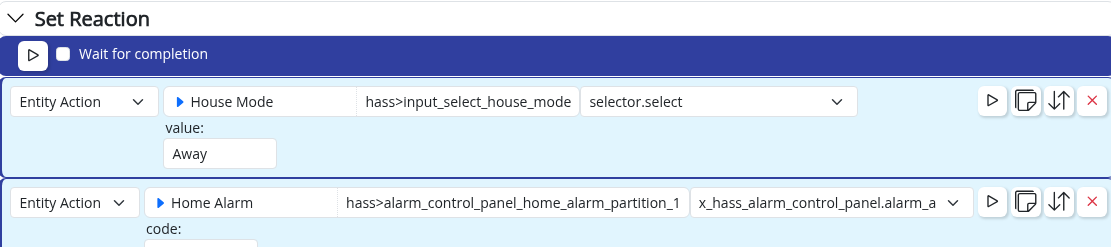
One thing that bothers me while doing work on new systems/new features, is that I cannot copy&paste actions, and I cannot drag&drop between set and resets.
#1 is for when I want to copy an action between different rules opened in two separate browser windows, while #2 is when I just need to flip a bunch of actions in the reset, or move some logic back and forth.
Both will be appreciated, but I understand the technical challenges. Thanks!
I'm currently on version 26011. I understand that the aarch64 image is no longer supported. So, I therefore need to update to the ARM64 image. Can anyone possibly suggest how I update my docker compose.yaml file (see below). Ideally I'd like to keep my existing reactions etc. rather than start from scratch.
# Multi-System Reactor template docker-compose.yml (version 22160)
#
# Change the lines indicated by "DO"...
#
services:
reactor:
container_name: reactor
environment:
# DO change the TZ: line to set your local time zone.
# See valid TZ list: https://en.wikipedia.org/wiki/List_of_tz_database_time_zones
TZ: GB
#
# DO NOT change this path. Your directory location is in "source" below.
REACTOR_DATA_PREFIX: /var/reactor
# DO change the image below to the one you are using (e.g. armv7l or aarch64 for RPi 4)
image: toggledbits/reactor:latest-aarch64
restart: "always"
expose:
- 8111
ports:
- 8111:8111
volumes:
# DO change the /home/username/reactor below to the directory you created for
# your local data; DO NOT change the /var/reactor part
- /home/pi/docker/reactor:/var/reactor
- /etc/localtime:/etc/localtime:ro
tmpfs: /tmp
Posts
-
Switched from RaZberry to UZB -
Moving to Docker@akbooer
I have been messing with this today. I do not currently run openluup through docker so this may not even be the best way to do this but it is what I did to get it up and running and with the ability to easily see and manipulate all openluup files within "File Station" on the synology.I created three folders on my synology:
/docker/openLuup/cmh-ludl
/docker/openLuup/logs
/docker/openLuup/backupsThen I created three volumes with a bind to the created folders
'openluup-env' bound to '/volume1/docker/openLuup/cmh-ludl'
'openluup-logs' bound to '/volume1/docker/openLuup/logs'
'openluup-backups' bound to '/volume1/docker/openLuup/backup'I used portianer but you can ssh into your synology and use the command line to create these volumes with the binds, see this
Then I created the container using portainer making sure to set the correct ports and volume mappings, which can also be done in the command line with
docker run -d \
       -v openluup-env:/etc/cmh-ludl/ \
       -v openluup-logs:/etc/cmh-ludl/logs/ \
       -v openluup-backups:/etc/cmh-ludl/backup/ \
       -p 3480:3480
       vwout/openluup:alpine
Hope this helps.
Edit: The binds are not necessary, I only did it to make it easy to access the files. Without the bindings, the volumes are somewhat hidden on synology that is not easily accessible for example at '/volume1/@docker/volumes/openluup-env/_data'
-
Delete all device in Room 101@akbooer said in Delete all device in Room 101:
Yes, absolutely (although I kind of wonder how you reached that figure...!)
The openLuup plugin has an action EmptyRoom101 with the parameter named AreYouSure which requires the value yes (to save nasty accidents.)
Thanks. I see it. They are all old verabridge devices ( and some z-way devices that I had to repair) that are no longer needed as I am fully cloned to z-way and mostly vera free
 (still have two zigbee door sensors on vera).
 -
Change Parameter of Z-wave device through Z-way APIParameters of devices can be set through the api using this URL
YOURIP:8083/ZWaveAPI/Run/devices[DEVICE#].instances[0].Configuration.Set(PARAMETER,PARAMETER_VALUE,size=PARAMETER_SIZE)
Replace:
YOURIP with the IP of Z-way for example 192.168.1.2.
DEVICE# with the Z-way device # of the devices parameter you want to change
Parameter with the parameter # you want to change
VALUE with the Parameter value
PARAMETER_SIZE with the size of the parameter (should be 1, 2, or 4)An example to change device 51's parameter 3 to a value of 1 with a size of 1:
192.168.1.2:8083/ZWaveAPI/Run/devices[51].instances[0].Configuration.Set(3,1,size=1)
To run it in Luup code
local status, result = luup.inet.wget("192.168.1.2:8083/ZWaveAPI/Run/devices[51].instances[0].Configuration.Set(3,1,size=1)", 5) -
MSR in Alpine Docker@toggledbits said in MSR in Alpine Docker:
OK. Let's see how this does in your hands. I've installed and uninstalled 3-4 times and it seems OK. In the bug tracker, go to #58, in the notes you'll find a download link and draft installation instructions. You can use the "monitor" function to follow that PR (emails you when things are posted--might get chatty with a lot of people in there, though). Please use that PR for reporting install-related issues.
This loads up nicely. Running unconfigured right now. I will transfer over my configs later and test it out.
-
Multi-System Reactor Developer Preview AVAILABLEAnother good release. Confirming that 0000078 and 0000077 are tested and working on my system.
-
Delete all device in Room 101@rafale77 said in Delete all device in Room 101:
Congrats on the move! Please report back on positive or negative effects.
Will do. Still working through things and figuring stuff out. So far, the experience has been mostly positive with a few minor hiccups. I also have some scripts I wrote that I plan to share that helped ease my transition.
-
MQTT – setup and useWhich synology NAS are you looking at? I have a DS920+ and run MQTT in a docker container. Works great and easy to set up. Some of the lower end ones may not support docker.
-
Almost there!Spinning up a dedicated VM on my synology right now in anticipation of the first preview. Can't wait!
-
Imperihome - missing devices@perh said in Imperihome - missing devices:
While i wait for a replacement app for my local UI devices, i want to use imperihome as long as I can.. But i'm missing a lot of devices!
All Z-Way bridge devices, all security/smoke and motion sensors (local RFXtrx child devices)..
Found the "include vera bridge" in imperihome.lua, what else could cause this?
I had the same issue. Check that the attribute "disabled" is not set to '1' for the missing devices. See this thread
-
Moving to Docker@akbooer said in Moving to Docker:
- but I can't access it at all or work out where the openLuup files go.
You are using the synology docker package to create and deploy your container, correct? At minimum, to get the container accessible, change the port settings to 3480(local):3480(container). Then you should be able access it at http://YourSynologyIP:3480/
-
MQTT Plugin@rafale77 It does allow you to subscribe.
You can subscribe to a topic by creating a child device :
Add a new device and choose a type (e.g. "D_BinaryLight1.xml" or "D_TemperatureSensor1.xml").
Reload LUUP engine.
Change the attribut "id_parent" with the id of the MQTT plugin device.
Reload LUUP engine and refresh your browser.
You should see variables "mqttTarget" and "mqttTopic" in your newly created device.
Set the topic you want to subcribe to and the target (format: service,variable=(formula in LUA)).
Reload LUUP engine.
If the payload of the received message is in JSON, the plugin will try to decode it and put it in the variable "payload" in the context of the LUA formula. -
Multi-System Reactor Developer Preview AVAILABLE@therealdb said in Multi-System Reactor Developer Preview AVAILABLE:
Can't wait for guidance on apdaters/plugins to contribute with Shelly and MQTT

MQTT will be huge.
-
Moving to Docker@akbooer said in Moving to Docker:
I understand that to make any changes last across container/NAS restarts, I need to make the volumes external to the container, as per the above yaml. So this is my next step.
Any further insights welcomed. Perhaps Portainer is that next step?
You cannot create named volumes through the synology GUI. You will need to use portainer or you can ssh into your synology and run the manual commands as outlined by vwout/openluup
You can also do this manually. Start by creating docker volumes:
docker volume create openluup-env
docker volume create openluup-logs
docker volume create openluup-backupsCreate an openLuup container, e.g. based on Alpine linux and mount the created (still empty) volumes:
docker run -d
-v openluup-env:/etc/cmh-ludl/
-v openluup-logs:/etc/cmh-ludl/logs/
-v openluup-backups:/etc/cmh-ludl/backup/
-p 3480:3480
vwout/openluup:alpine -
MQTT Plugin -
Sunset with offset didn't run@cw-kid said in Sunset with offset didn't run:
Also I have seen this saving problem on more than just one rule.
I've seen in on a few rules when either adding items like additional triggers or removing items.
Then you cannot click either of the two save buttons.
Only the red exit w/o saving button works.
I have been able to possibly reproduce your saving issue. I have noticed with rules that have a Date/Time After Trigger cannot be modified and saved.
-
Moving to DockerI think I had this same issue. If you copy the files in cmh-ludl from an existing openluup install into ' /OpenLuup/openluup-env' it should start right up.
-
MSR in Alpine Docker@kfxo said in MSR in Alpine Docker:
@toggledbits said in MSR in Alpine Docker:
OK. Let's see how this does in your hands. I've installed and uninstalled 3-4 times and it seems OK. In the bug tracker, go to #58, in the notes you'll find a download link and draft installation instructions. You can use the "monitor" function to follow that PR (emails you when things are posted--might get chatty with a lot of people in there, though). Please use that PR for reporting install-related issues.
This loads up nicely. Running unconfigured right now. I will transfer over my configs later and test it out.
Just an update, I copied over config and storage directories to the mounted docker volume and Reactor would not start until I also created a 'logs' directory in the mounted docker volume. All looked well after that but going to continue to run it on my Debian VM for now.
-
Moving to DockerThere is a post from me above in this thread (sorry don't know how to link specific post) that explains how I got it to work. Have you tried that? I think the issue is synology gui does not support the correct type of volumes and you have to ssh into synology and run the correct docker command to set it up.
-
Timers in my logThat actually makes perfect sense and upon further inspection I see that the timers I was noticing in the logs are with respect to one rule that I had recently turned on that resets often.